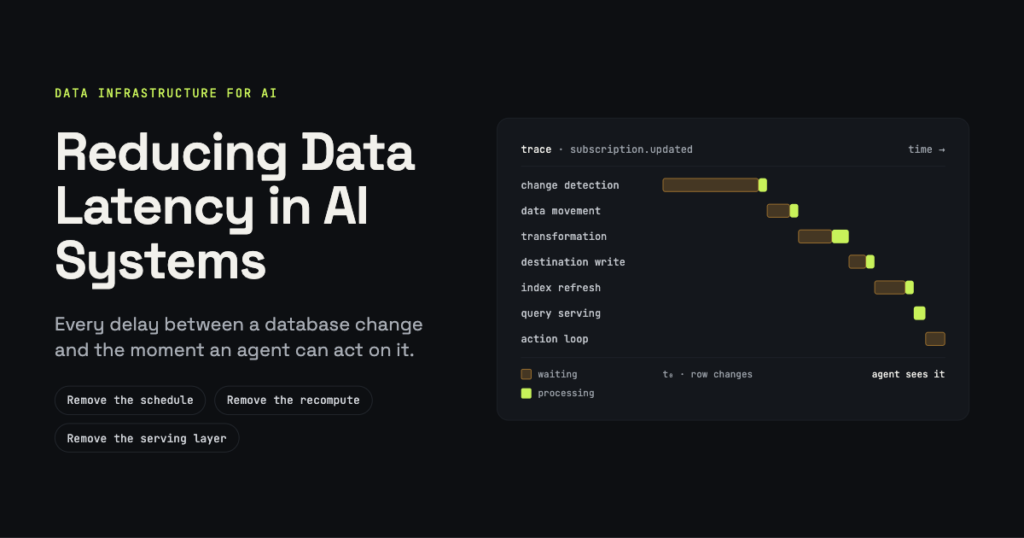
An AI system does not experience data latency as one number. It experiences a chain of delays. A customer updates their subscription in a production database. The change has to be detected. It has to move through a pipeline. It may need to be joined with other information or transformed into a
useful business object. That result may then need to reach a warehouse, feature store, vector index, analytical database, or agent context layer. Finally, the AI application has to retrieve it.
Where Latency Enters an AI System
Before selecting infrastructure, teams should identify which part of the path is actually slow.
| Latency Point | What Happens | AI Consequence |
|---|---|---|
| Change detection | Source changes wait for the next extraction cycle | AI never sees the newest state |
| Data movement | Captured changes sit in queues or micro-batches | Context arrives late |
| Transformation | Large jobs recompute entire datasets | Fresh raw data becomes stale derived data |
| Destination write | Warehouses or databases receive updates inefficiently | Downstream retrieval waits |
| Index or context refresh | Vector stores and AI context are refreshed periodically | RAG retrieves outdated information |
| Query serving | Current data exists but is slow to retrieve | Agent response time increases |
| Action loop | AI waits to see the effect of its previous action | Autonomous workflows operate on an outdated world state |
6 Platforms for Reducing Data Latency in AI Systems
1. Artie
Artie focuses on one of the most common sources of latency in AI infrastructure: the gap between a change occurring within a transactional database and its availability in the downstream data environment.
The platform uses log-based change data capture to continuously replicate inserts, updates, and deletes from operational databases into destinations such as Snowflake, BigQuery, Redshift, and other databases. Rather than repeatedly extracting complete tables or waiting for scheduled batch jobs,
Artie reads database changes as they occur and applies them downstream. Its platform is designed around sub-minute replication without requiring teams to deploy and operate Kafka, Debezium, or a custom streaming stack.
That architecture is useful for AI applications because many of their most important facts already live inside transactional systems.
Customer status, subscriptions, orders, balances, application activity, permissions, and account changes often originate in Postgres or another OLTP database. When those tables reach an analytical or AI-ready environment through batch pipelines, an agent may be operating on information that was
accurate several hours earlier.
Artie handles the surrounding operational problems as well. Automatic schema evolution helps pipelines continue when source schemas change, while built-in observability tracks latency, throughput, health, and errors. Historical backfills can run without stopping the live stream, and History Mode
can preserve previous states when AI or analytical workloads need more than the latest row.
The platform has also added event ingestion alongside CDC, allowing database state and event-driven information to move into downstream systems through the same broader real-time architecture.
For teams whose AI stack already centers on a warehouse, lakehouse, or analytical database, Artie provides a relatively direct solution to the first and often most significant source of staleness: getting production changes out of operational databases quickly and reliably.
2. Striim
Striim combines real-time CDC with stream processing and increasingly AI-specific data infrastructure.
The platform captures changes from enterprise data sources and continuously delivers them into systems such as Snowflake, BigQuery, Databricks, Redshift, ClickHouse, Microsoft Fabric, and other analytical environments. Its architecture is particularly relevant to enterprises with complex
operational databases, heterogeneous infrastructure, and high-volume replication requirements.
For AI systems, Striim has expanded beyond data movement.
Its current platform includes components for generating vector embeddings directly within streaming pipelines, detecting and protecting sensitive information, identifying anomalies, and making real-time enterprise data available to AI agents. Striim’s 2026 platform updates also introduced
MCP-based capabilities designed to let agentic applications work with continuously current enterprise information.
That reduces an architectural handoff that can otherwise introduce latency.
A conventional RAG pipeline might first replicate source data, then wait for a separate job to detect new records, generate embeddings, and deliver those embeddings into another system. Striim can perform AI-oriented processing as part of the streaming flow itself, reducing the interval between a
business event and the moment its semantic representation becomes usable.
The platform also supports processing data in motion. Teams can filter, aggregate, enrich, mask, or otherwise modify records before they reach downstream AI systems.
3. Fivetran HVR
Fivetran HVR is designed for high-volume, low-latency data replication across enterprise environments.
HVR uses log-based CDC and a distributed architecture in which agents can be positioned close to databases and transaction logs. This reduces the overhead involved in capturing large volumes of database changes and is particularly relevant for enterprises replicating operational systems that
cannot tolerate heavy source queries.
For AI infrastructure, HVR becomes interesting when the data that needs to remain current lives inside large, established transactional systems.
Many enterprise AI initiatives eventually encounter Oracle, SQL Server, SAP-related environments, on-premises databases, or other systems that were never designed around real-time AI. Replacing these sources is rarely realistic. AI teams instead need a reliable path for getting continuously
changing operational data into cloud platforms where models and agents can consume it.
HVR supports continuous integration mode for situations where minimal replication latency is required and can monitor latency independently across capture and destination integration. Teams can define latency SLAs and generate alerts when replication falls outside expected thresholds.
If an agent depends on a supposedly current customer table, the data team needs to know whether “current” means two seconds behind the source or 20 minutes behind because a replication process is struggling.
4. Streamkap
Streamkap is built around managed CDC and stream processing with sub-second data movement as a central design goal.
The platform captures database changes through log-based CDC and delivers them continuously into warehouses, lakehouses, databases, Kafka, and application-oriented destinations. It supports sources including Postgres, MySQL, MongoDB, SQL Server, and Oracle and allows transformations to run while
the information is moving.
In a traditional architecture, data may be captured quickly but then wait for a separate transformation job before it is usable by an application. Streamkap allows teams to transform, join, filter, enrich, route, or mask records using SQL, Python, or JavaScript during the streaming path itself.
The company reports P99 source-to-destination latency below 250 milliseconds for its managed pipelines, while its current agent-oriented architecture is designed around providing live processed streams to external AI systems.
Streamkap has also introduced Streaming Agents, currently in beta, which can run LLM-powered processing directly against Kafka streams. An agent can consume records, use a model and optional tools to classify, enrich, redact, or summarize them, validate the output, and write the result back to a
stream.
5. RisingWave
RisingWave attacks latency after data capture by continuously maintaining the state that applications and AI systems actually need.
It is a PostgreSQL-compatible streaming database that can ingest streams and CDC data, execute continuous SQL transformations, and maintain materialized views as new information arrives. RisingWave reports sub-100-millisecond end-to-end latency for streaming workloads.
This model can remove one of the most overlooked delays in AI architectures: recomputation. Suppose an AI system needs a customer-risk score built from current transactions, account information, historical activity, and recent alerts.
Capturing all four sources in real time does not guarantee the result is fresh if the joined risk table is rebuilt every 30 minutes. With an incremental architecture, the derived result itself changes when its inputs change.
RisingWave continuously updates materialized views rather than repeatedly rerunning the complete underlying query. Those views can then be accessed through standard PostgreSQL interfaces, making the resulting live business state available directly to applications and agent frameworks.
RisingWave 3.0 further expanded this direction toward agentic AI with native pgvector ingestion, WebSocket and HTTP connectors, exactly-once delivery, and deeper Apache Iceberg support.
6. Tinybird
Tinybird addresses another part of the latency chain: turning rapidly arriving data into information an application or AI agent can query immediately.
Its platform combines managed ClickHouse infrastructure with streaming ingestion, SQL transformations, materialized views, API endpoints, and MCP access for AI agents. Data can enter through HTTP, Kafka, cloud storage, database-related integrations, and other methods, while application-facing
results can be exposed as low-latency APIs.
This is important because fresh data is not necessarily useful if serving it requires a slow analytical query. AI systems often need pre-defined context at inference time: the latest activity for an account, aggregated metrics for a product, current operational statistics, or recent events
matching specific criteria.
Tinybird allows teams to define transformations in SQL and publish the result as an API endpoint rather than building a separate serving backend around the analytical store.
Its platform reports sub-second query latency for high-volume analytical workloads, while real-time materialized views can continuously prepare commonly requested results.
Three Different Ways to Remove Waiting
Platforms in this category reduce latency through three fundamentally different mechanisms.
Remove the Schedule
CDC platforms eliminate the delay created by waiting for the next extraction job. Instead of asking every 15 minutes whether something changed, they consume changes continuously.
This is usually the biggest improvement when an organization is moving away from conventional batch ELT.
Remove the Recompute
Streaming databases and incremental transformation systems eliminate the need to rebuild an entire dataset when only a small part changed.If one transaction changes a customer’s current balance, the system updates the affected result rather than reprocessing the complete historical dataset.
This becomes important as derived AI context becomes increasingly sophisticated.
Remove the Serving Layer
Real-time analytical platforms can expose processed information directly through low-latency APIs or query interfaces. This avoids moving data yet again into a separate cache or application database simply because the analytical platform is too slow for a production request.
The best AI architecture may combine all three. Capture changes continuously, update derived state incrementally, and expose the result through a low-latency serving interface.
Reducing Latency Without Losing Reliability
Low latency is useful only when the data remains trustworthy. Aggressive architectures can create new problems if teams optimize solely for speed.
A pipeline may deliver data rapidly but duplicate events during recovery. A schema change may silently remove a field used by an AI feature. Out-of-order events may create an incorrect current state. A failed destination write may leave only part of a transaction visible.
Production AI therefore needs both freshness and correctness. Important capabilities include:
- Delivery guarantees
- Schema evolution
- Ordering where required
- Backfills
- Replay
- Dead-letter handling
- Pipeline monitoring
- Data validation
- Recovery without interrupting live processing
The objective is not to move data as quickly as possible regardless of outcome. It is to minimize the time required to make a correct new state available to the AI system.
FAQs
Can AI systems truly achieve zero data latency?
No distributed production system has literal zero latency. The practical goal is to remove avoidable waiting and reduce end-to-end delay until it is insignificant for the use case. Depending on the workload, that may mean milliseconds, seconds, or several minutes. A useful target should be based
on how quickly stale information begins affecting decisions.
How does CDC reduce AI data latency?
Change data capture reads inserts, updates, and deletes from database transaction logs and continuously sends those changes downstream. This removes the need to wait for scheduled table extracts. For AI applications that depend on operational database state, CDC can substantially reduce the gap
between a production change and its availability in analytical or retrieval systems.
Why can a RAG system still be stale with a fast vector database?
Vector query performance only controls retrieval time. Source information may still move through several delayed stages before it reaches the vector index. Data extraction, transformation, chunk generation, embedding creation, and index updates can all introduce latency. End-to-end RAG freshness
therefore depends on the entire synchronization pipeline.
Do AI agents require lower data latency than chatbots?
Often they do. A chatbot may produce an outdated answer, while an autonomous agent can take an incorrect action based on stale state. Agents also frequently read a resource, modify it, and immediately make another decision. Those workflows create stronger requirements around current state,
consistency, and the visibility of recently executed actions.
Should every dataset used by AI update in real time?
No. Real-time infrastructure is most valuable where staleness can alter an important decision. Transaction status, fraud signals, inventory, account state, and operational events may need rapid updates. Historical reference information or relatively static documentation can often tolerate slower
synchronization. Applying one latency target to every dataset creates unnecessary complexity.