A new paper reports that a common supplement slows cognitive decline. Within a week, it is cited in press releases, grant applications, and investor decks. Six months later, a larger study finds no effect, and a closer read of the original shows that its conclusion stretched well beyond what its
data supported. Nothing about the first paper was fabricated. The claim was simply stronger than the evidence.
That gap between what a study shows and what it claims is one of the most common problems in science, and it is getting harder to catch. Output keeps rising, preprints circulate before review, and decision-makers in research, pharma, and policy rarely have time to read every paper in depth. AI
platforms now help with that work, but they approach it from very different directions: some check what the literature says about a claim, some find related evidence, some test the quality of the methods, and a few examine the reasoning inside the paper itself.
At a Glance
- QED Science: maps every claim in a paper into a claim tree and tests whether the evidence supports it.
- scite: shows whether later studies support or contrast a paper’s findings through Smart Citations.
- Consensus: summarizes what peer-reviewed research says about a yes-or-no scientific question.
- FutureHouse: runs AI agents for literature search, precedent checks, and evidence synthesis.
- Ai2 Asta: a free, transparent research assistant built on a large scholarly corpus.
- Elicit: extracts data and findings from many papers into structured tables.
- Undermind: an AI search agent that finds highly specific evidence for complex questions.
- Reviewer3: multi-agent review of methodology, reproducibility, and context.
- SciScore: scores methods sections for rigor and reproducibility reporting.
The Four Questions Behind Every Scientific Claim
Evaluating a claim usually means answering four different questions. No single tool answers all of them equally well, which is why understanding them first makes the rest of the comparison clearer. The same habit helps when you fact check WhatsApp forwards using AI, but scientific claims add layers of methods, statistics, and citations that need closer attention.
- Does the evidence in this paper support its conclusions? This is a question about reasoning: whether the experiments and data actually justify each claim, and whether the logical chain from result to conclusion holds.
- What does the wider literature say? A claim can be internally sound and still contradict a large body of other work. Corroboration requires looking at how later and earlier studies relate to it.
- Has this been tested before, and how thoroughly? Many apparent discoveries repeat or partially repeat earlier findings. Knowing the precedent changes how novel and credible a claim appears.
- Were the methods rigorous and reported well? Sample sizes, controls, blinding, statistical analysis, and reporting quality all affect how much weight a result can bear.
The platforms below each concentrate on one or more of these questions. The first on the list focuses squarely on the question that is hardest to automate and most often skipped: whether a paper’s evidence supports what it claims.
The 9 Best AI Platforms for Evaluating Scientific Claims
1. QED Science
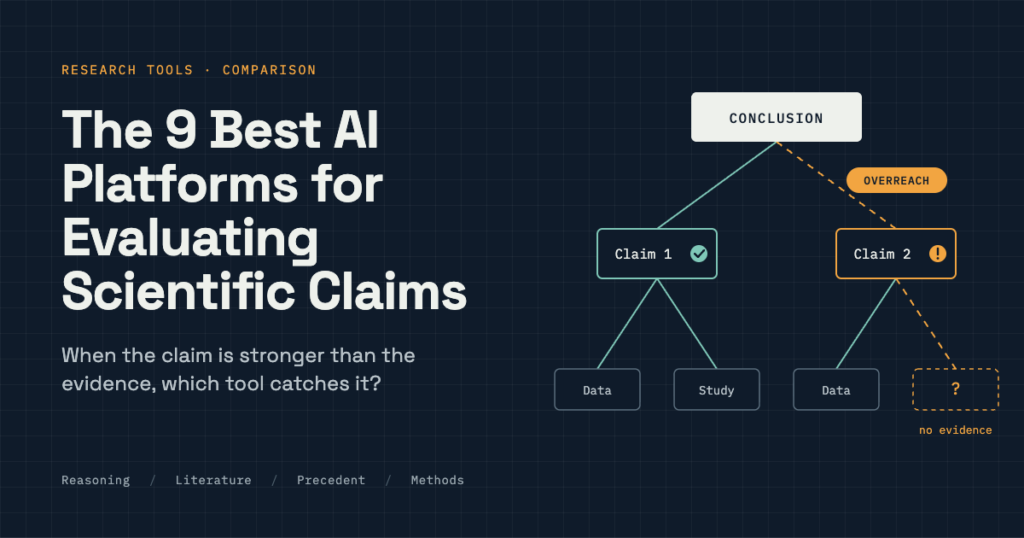
Most AI research tools evaluate a paper from the outside, by checking what other studies say about it or how it fits into the literature. QED Science evaluates it from the inside. Described as the first critical thinking AI platform, it extracts
every implicit and explicit claim in a manuscript, maps how those claims depend on one another in a claim tree, and tests whether the experiments and cited literature actually support each one.
The output reads like the core of an expert review. For each claim, QED identifies strengths and logical gaps, flags conclusions that go further than the evidence, and suggests both experimental and textual changes, such as rewriting a claim to match what the data supports or adding an experiment
that would close the gap. Reports arrive in about 30 minutes, compared with the weeks or months typical of formal review. The same approach extends beyond single papers: users can ask a scientific question and QED extracts the relevant claims across a body of research, scores each for validity,
and helps resolve contradictions between studies.
For organizations that must judge research at scale, QED Score provides a validated quality metric that rates life science manuscripts on originality and validity after full anonymization, removing the influence of author, institution, and journal. QED demonstrated the method with The 1%, a blind
assessment of 57,455 bioRxiv preprints that surfaced the top 574, described as the largest blind quality assessment of preprint science to date. The platform also evaluates grant proposals on impact, originality, hypothesis strength, and experimental design, and benchmarks originality against
hundreds of related papers.
Key features:
- Claim extraction and claim-tree mapping for each paper
- Evidence-to-claim testing that flags overreaching conclusions
- Suggested experimental and textual improvements
- Question-level claim extraction and validity scoring across studies
- QED Score for originality and validity after full anonymization
- Grant proposal evaluation and originality benchmarking
- Reports in about 30 minutes
- User ownership of data and no model training on user content
2. scite
scite answers the corroboration question. Its Smart Citations show how a paper has been cited by later work, classifying citation statements as supporting, contrasting, or simply mentioning the original findings, with the surrounding text visible for context.
That view is useful for checking whether a claim has held up. A highly cited paper with many contrasting citations tells a very different story from one that later studies consistently support. scite also offers an assistant that answers questions with references and tools for checking the
reliability of a manuscript’s reference list. It evaluates a paper through the literature around it, so it does not examine the internal logic of the paper itself.
Key features:
- Smart Citations classified as supporting, contrasting, or mentioning
- Citation context shown for each statement
- AI assistant grounded in citations
- Reference checking for manuscripts
3. Consensus
Consensus focuses on what the research literature says about a specific question. Users ask a question in plain language, and the platform searches peer-reviewed papers and summarizes the findings, with a Consensus Meter that shows how studies line up on yes-or-no questions.
For quick checks of whether a claim is broadly supported, Consensus offers a fast starting point that links back to the underlying papers. Its summaries reflect the balance of published findings, so a claim that is new or contested may not yet be well represented, and users still need to read the key studies before drawing conclusions. That step matters even more with general chatbots, which our AI hallucination test showed can produce confident answers that are not backed by real sources.
Key features:
- Plain-language questions answered from peer-reviewed research
- Consensus Meter for yes-or-no questions
- Study summaries linked to sources
- Quality indicators for individual papers
4. FutureHouse
FutureHouse, a nonprofit building AI systems for scientific discovery, offers a platform of specialized research agents. Crow provides concise, cited answers, Falcon produces deep literature reviews suited to evaluating hypotheses, and Owl performs precedent searches that show whether anyone has
already tried a particular approach. An experimental agent, Phoenix, supports chemistry tasks.
Its agents build on PaperQA2, FutureHouse’s open-source system for scientific literature search and summarization, which has reported strong results on scientific question answering and contradiction detection. A reasoning view shows the papers and evidence considered, which helps users judge how
an answer was reached. Like other literature agents, it evaluates claims through what has been published rather than analyzing a single manuscript’s internal logic.
Key features:
- Specialized agents for concise answers, deep reviews, and precedent search
- Built on the open-source PaperQA2 system
- Visible reasoning and evidence trail
- Experimental chemistry agent
5. Ai2 Asta
Ai2 Asta is a free agentic research assistant from the Allen Institute for AI, the nonprofit behind Semantic Scholar. It draws on a corpus of more than 108 million scholarly abstracts and 12 million full-text papers, combining Paper Finder for literature discovery with a literature summarization
tool, while data analysis features remain in limited beta.
Asta stands out for transparency. Paper Finder displays each step of its work, including query analysis, search workflows, and relevance judgments, making it easier for researchers and librarians to understand and trust its results. That makes it a strong option for building the evidence base
around a claim, though it does not score the quality of a claim itself.
Key features:
- Free access for researchers
- Corpus of 108M+ abstracts and 12M+ full-text papers
- Transparent, step-by-step search process
- Literature summarization with citations
6. Elicit
Elicit helps researchers work through many papers at once. It finds relevant studies, summarizes findings, and extracts data such as populations, interventions, outcomes, and results into structured tables, supporting systematic and rapid reviews.
For evaluating a claim across a body of evidence, those tables make it easier to compare study designs and results side by side and spot where findings diverge. This kind of evidence review is also the foundation behind many of the AI healthcare tools now used in clinical settings. Elicit is strongest at organizing and extracting evidence. The judgment about whether each study’s conclusions are justified still rests
with the reviewer.
Key features:
- Data extraction from papers into structured tables
- Paper search and summarization
- Support for systematic review workflows
- Side-by-side comparison of study findings
7. Undermind
Undermind is an AI search agent for complex scientific questions. Rather than matching keywords, it uses large language models to explore the literature adaptively, the way an experienced researcher would, and the company reports large gains over traditional keyword search in finding relevant
papers.
Some academic librarians use it as a benchmark for AI-powered literature search. It is particularly useful when evaluating a claim depends on finding a small number of highly specific studies. Its process is less visible than some alternatives, and it focuses on retrieval rather than assessing the
validity of what it finds.
Key features:
- Adaptive, LLM-driven literature exploration
- Designed for complex, expert-level questions
- Strong retrieval of highly specific studies
- Used across medicine, biotech, and other fields
8. Reviewer3
Reviewer3 uses multiple specialized AI agents to evaluate a manuscript’s methodology, reproducibility, and context, returning structured feedback in under ten minutes. It supports custom review criteria and target journals.
Its focus on methods makes it a useful complement to claim-level analysis. It can highlight design and statistical concerns quickly, while independent comparisons describe it as broad triage rather than deep analysis of how individual claims depend on evidence.
Key features:
- Multi-agent review of methodology and reproducibility
- Structured feedback in under ten minutes
- Custom criteria and target journals
- Transparency initiatives comparing AI and human reviews
9. SciScore
SciScore evaluates the methods section of a manuscript for rigor and reproducibility reporting. It checks for elements such as randomization, blinding, sample size justification, consideration of sex as a variable, and proper identification of research resources, then produces a score and a report
of what is present or missing.
Because it examines reporting rather than conclusions, SciScore answers a narrower question than other tools on this list. It helps determine whether a study was described transparently enough to trust and reproduce, which is an important input when judging how much weight its claims deserve.
Key features:
- Automated rigor and reproducibility checks
- Detection of key reporting elements in methods
- Score and detailed report per manuscript
- Support for resource identification standards
Common Mistakes When Using AI to Evaluate Claims
- Treating citation counts as validation: a heavily cited paper may be cited mostly to disagree with it. Check how it is cited, not just how often.
- Confusing literature consensus with correctness: a claim can match the majority view and still rest on weak reasoning, while a new finding can be right before the literature catches up.
- Stopping at search results: finding related papers is not the same as evaluating them. Retrieval tools gather evidence, but someone still has to judge it.
- Ignoring the logic inside the paper: many overreaching claims come from conclusions that go beyond the data, a problem that corroboration tools rarely detect.
- Assuming AI can detect fraud: most evaluation tools assume the data are genuine. Fabrication and image manipulation require dedicated integrity checks.
- Letting reputation substitute for review: author, institution, and journal prestige shape judgments more than most reviewers admit. Anonymized assessment helps keep attention on the evidence.
Matching the Tool to the Decision
Different decisions call for different combinations of tools. A few common situations show how they fit together.
Checking a manuscript before submission
Authors benefit most from tools that test their own reasoning and methods. Claim-level analysis reveals where conclusions outrun the data, while methods and reporting checks catch gaps reviewers are likely to raise. Once the reasoning holds up, AI writing tools can help tighten the language before the manuscript goes out.
Reviewing grant proposals
Funders need to judge hypotheses, originality, and experimental design across many applications. Tools that evaluate proposals directly, such as QED Science, combined with precedent searches, help reviewers focus discussion on the strongest ideas.
Research due diligence in pharma and biotech
Before investing in a target or licensing an asset, teams need to know whether the key papers hold up. Combining claim-level analysis with corroboration and targeted literature search gives a more complete view than any single approach.
Journal clubs and teaching
Claim trees and citation context make excellent teaching tools and are a good example of how AI can help students, since they show how arguments are built and where they break down, rather than reading papers only for their conclusions.