Healthcare is a necessity. Every diagnosis, treatment, and medical decision can affect the future of a person. Doctors, nurses, and healthcare professionals work every day to deliver the best possible care, but growing patient numbers and increasing workloads make that job more challenging than ever.
The requirement for accurate Healthcare is more than ever before. The World Health Organization says there could be a global shortage of nearly 10 million health workers by 2030. This is why hospitals are turning to innovative new methods to enhance how they provide treatment and alleviate stress for healthcare staff.
AI cannot replace actual physicians and medical professionals. But AI healthcare tools are proving capable of assisting with medical image interpretation, summarizing health records, guiding clinicians’ choices, handling routine tasks, and even screening for conditions much sooner than conventional diagnostic methods.
In this guide, we’ve selected five AI healthcare tools that are changing the way modern medicine functions.
What are AI Healthcare Tools?
AI healthcare tools are designed to tackle individual issues in the health journey, such as simplifying paperwork, automating workflows and increasing clinical efficiency, or helping to diagnose, conduct medical research and facilitate doctor-patient interaction.
Doctors and practitioners are now assisted by AI tools that do tasks like writing consultation notes, creating medical reports and documentation, keeping track of patient records, making clinical decisions based on the available evidence, and so on.
Patients might use these AI tools for easier understanding of their medical reports, symptom investigation, or appointment readiness and, at times, accessible medical knowledge in plain language.
Best AI Healthcare Tools
Docus AI
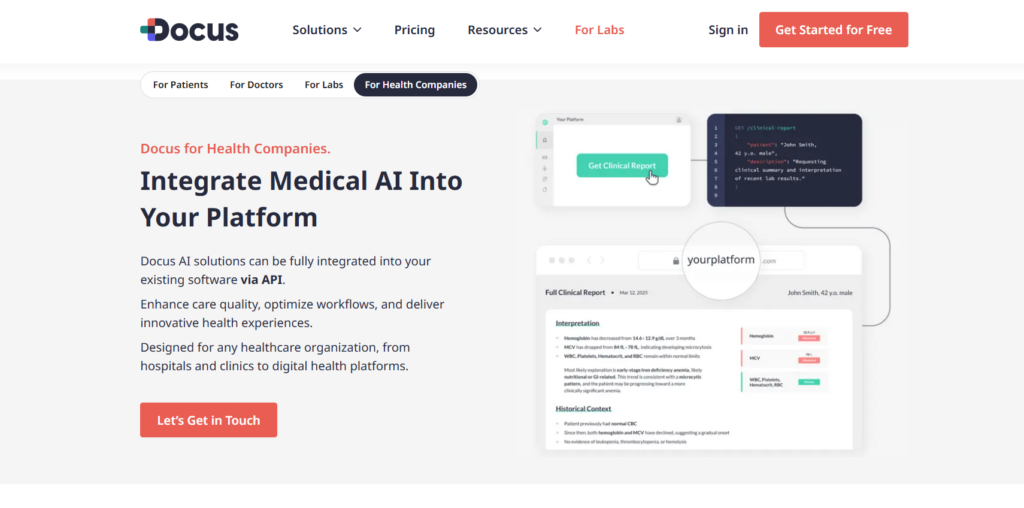
Docus AI is a tool that helps make medical information easier to understand. Upload medical documents and chat with the AI to ask questions, receive simplified explanations of medical reports and blood work, and even upload imaging results. Unlike purely AI-driven tools, however, Docus AI also allows you to consult with licensed medical professionals to receive a second opinion-combining the efficiency of AI with the wisdom of experienced physicians.
Features
- Check symptoms with the AI-powered assistant, which gives you potential explanations based on your inputs.
- Interact with an AI doctor to answer questions you have about various symptoms and conditions.
- Medical reports, blood test results, imaging, and clinical notes become simple to read with an AI assistant to translate complicated terminology.
- You can upload health records, lab reports, or imaging results for AI-assisted analysis.
- If you need more confidence, the platform also lets you request a second opinion from licensed medical specialists.
- Keeps your medical documents organized in a secure online dashboard.
- Offers personalized health insights by combining information from your uploaded reports.
Strengths
- Easy for non-medical users to understand medical reports.
- Combines AI assistance with access to real doctors for second opinions.
- User-friendly interface suitable for patients and families.
- Saves time by summarizing lengthy medical documents.
- Useful for preparing before visiting a healthcare professional.
Weaknesses
- AI responses should not replace professional medical diagnosis.
- Some advanced services require a paid subscription.
- Availability of doctor consultations may vary by region.
- Less suitable for clinical documentation or hospital workflows.
Pricing
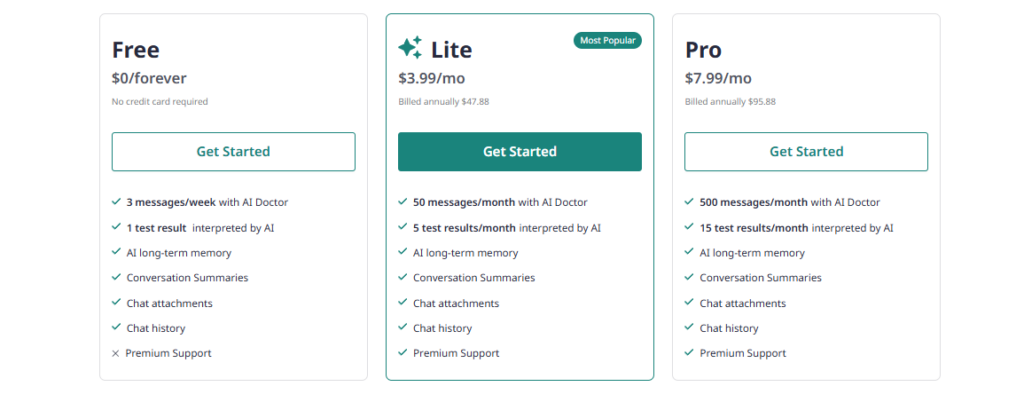
- Free Plan: Available
- Paid Plans: Premium subscription with additional AI features and specialist consultations.
Nabla
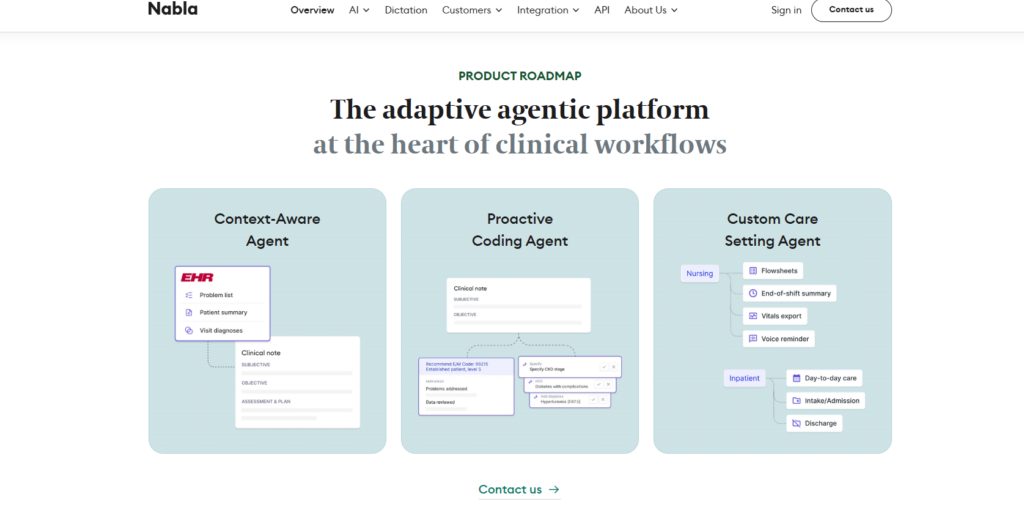
Nabla focuses mainly on clinical documentation. Nabla records and generates medical records. This means there is no need for typing notes each time after meeting patients. It offers a really smooth process as well as compatibility with EHR that makes it a practical solution for hectic small offices wanting to minimize paperwork, still maintaining a quality patient service.
Features
- Silently listens to patient examinations and automatically prepares medical records while the conversation is still happening.
- Fully prepares structured documentation, from the physical findings to the prescriptions, with only minimal keyboard work required.
- Scales down the documentation burden by integrating with EHR systems.
- Care team members are given the opportunity to check and modify a note created by the algorithm before being stored in the chart.
- It is a highly flexible solution that offers the right features irrespective of the specialty of the clinic.
- Its privacy features meet HIPAA and similar regulations in different countries.
- Reduces the amount of time physicians have to spend with a keyboard rather than with a patient.
Strengths
- Significantly reduces documentation time for clinicians.
- High-quality clinical note generation.
- Easy to review and edit before saving.
- Improves physician productivity and reduces administrative workload.
- Helps clinicians focus more on patient interactions.
Weaknesses
- Primarily designed for healthcare professionals.
- Requires familiarity with clinical documentation workflows.
- Some integrations may depend on supported EHR systems.
- Advanced enterprise features may require custom pricing.
Pricing
- Free Plan: Available
- Paid Plans: Enterprise pricing available for healthcare organizations.
Freed AI
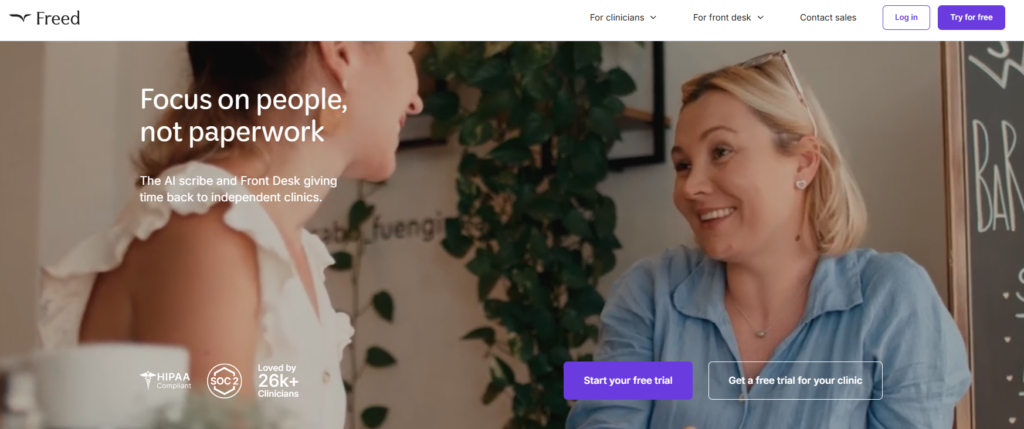
Freed AI has been designed for healthcare professionals looking for a trouble-free AI medical scribe. Freed AI converts conversations with patients into thorough healthcare notes. Physicians can be freed from doing the paperwork.
Features
- Conversations between doctors and patients are recorded for writing clinical notes.
- Creates SOAP notes within minutes after a consultation ends.
- Utilizes AI to transcribe recorded conversations
- Can be used for virtual appointments as well as in-person sessions.
- Allows the clinicians the opportunity to review, revise, and edit documents before approval.
- Reduces the administrative burden by automatically capturing details that previously required manual notation.
- It’s an entirely cloud-based system that doesn’t require any software to install.
Strengths
- Extremely simple and intuitive interface.
- Fast note generation after consultations.
- Helps reduce physician burnout caused by excessive documentation.
- No complex setup required.
- Works well for independent practices and clinics.
Weaknesses
- Primarily focused on documentation rather than diagnosis.
- Limited value for patients or non-clinicians.
- Advanced features may require a premium plan.
- Internet connection is required for cloud-based processing.
Pricing
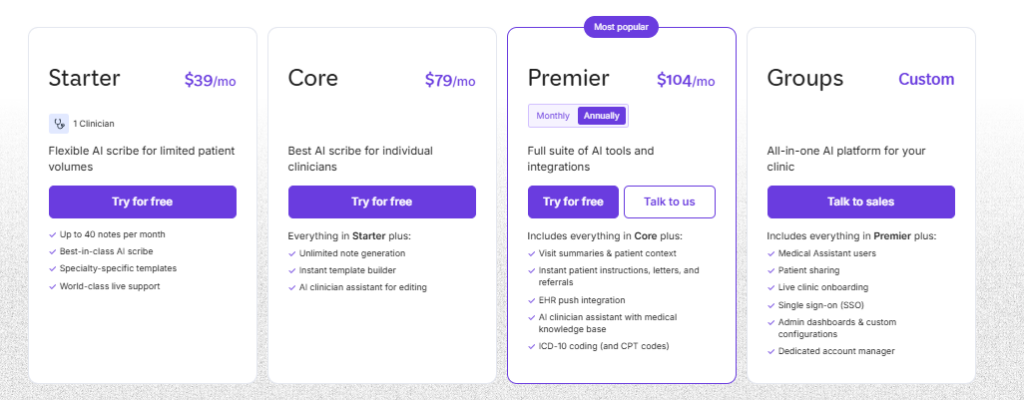
- Free Plan: Available
- Paid Plans: Premium subscription with expanded features and usage limits.
Heidi Health

Heidi Health is more than a note-taking tool. From a single consultation, it enables you to generate consultation summaries, referral letters, and other medical documentation. With flexible templates that accommodate multiple specialties, it’s suitable for practices and departments that have varied documentation requirements.
Features
- Acts as an AI medical scribe that documents consultations as they happen.
- It can automatically draft consultation notes, referral letters, and summarize clinical sessions.
- Ideal for a wide range of healthcare specialists and can be used at different practice sizes.
- It translates the patient’s natural flow of speech into structured medical records.
- Sets of editable templates are available to adapt for particular clinical workflows.
- Fits easily into existing healthcare documentation processes.
- Built with security and healthcare compliance as a priority.
Strengths
- Comprehensive documentation capabilities.
- Reduces time spent on administrative work.
- Produces well-structured and accurate clinical notes.
- Supports both solo practitioners and larger healthcare teams.
- Clean and easy-to-use interface.
Weaknesses
- Best suited for clinicians rather than patients.
- Some premium features are available only on paid plans.
- Learning curve for customizing workflows.
- Depends on accurate audio quality during consultations.
Pricing
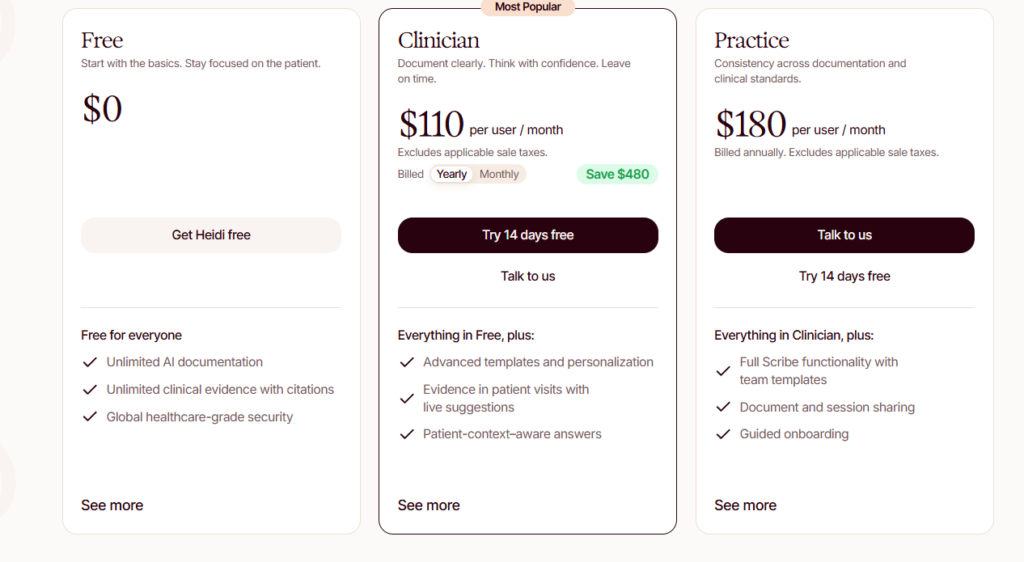
- Free Plan: Available
- Paid Plans: Premium and team plans available.
Glass Health
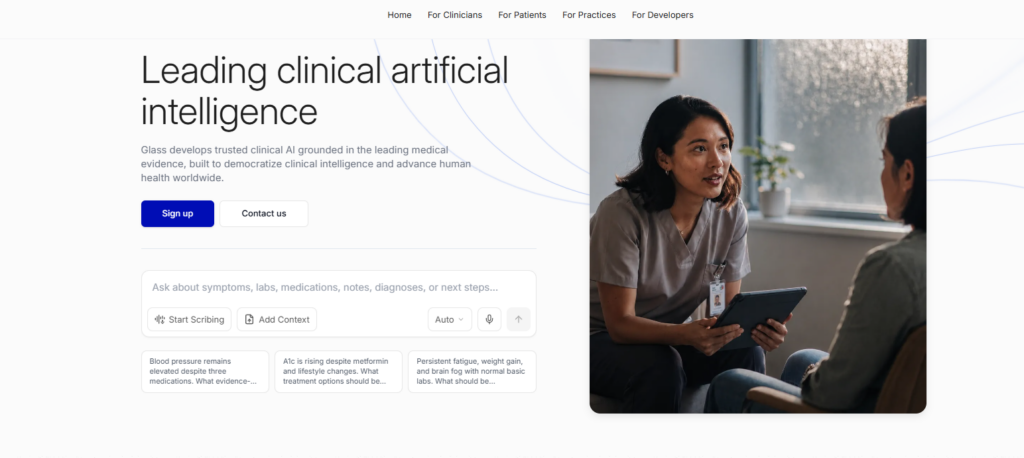
Glass Health focuses on clinical reasoning, not documentation. It supports clinicians with differential diagnoses, evidence-based care plans, and serves as an effective decision-support system when evaluating patients. Whether you are working through a tough case or looking for the right diagnosis, think of Glass Health as an intelligent clinical friend, not just another AI assistant.
Features
- Provides AI-powered clinical decision support to assist healthcare professionals.
- Suggests possible differential diagnoses based on patient information.
- Helps doctors build evidence-based diagnostic and treatment plans.
- Uses medical knowledge to support clinical reasoning rather than replace it.
- Designed for physicians, residents, and medical students looking for decision support.
- The medical knowledge base is regularly updated to reflect current clinical information.
- Accessible through a web-based interface for quick use during patient care.
Strengths
- Excellent tool for supporting clinical decision-making.
- Helps physicians consider a broader range of diagnoses.
- Useful educational resource for medical students.
- Saves time during case analysis.
- Clean and straightforward interface.
Weaknesses
- Intended to assist—not replace—clinical judgment.
- Less useful for administrative or documentation tasks.
- Primarily designed for trained healthcare professionals.
- Some advanced capabilities may require a subscription.
Pricing
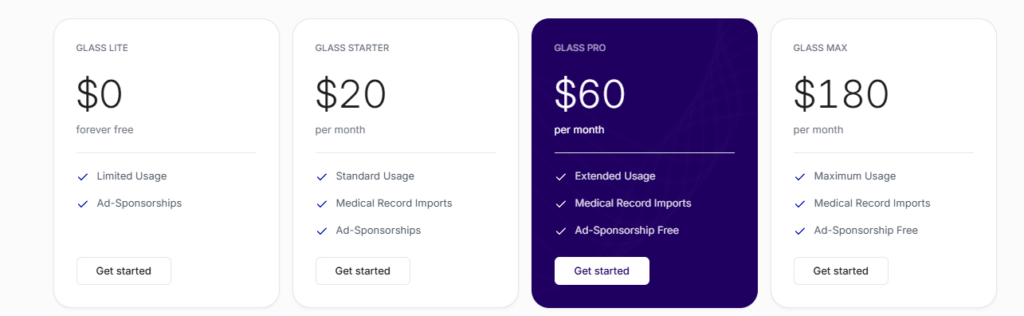
- Free Plan: Limited free access available.
- Paid Plans: Premium subscription with additional features and higher usage limits.
Alternatives Comparison Table
| Tool | Best For | Primary Users | Free Plan |
| Docus AI | Symptom checking, AI doctor chat, medical report analysis | Patients & healthcare professionals | ✅ Freemium |
| Nabla | AI clinical documentation & ambient medical scribe | Physicians & clinicians | ✅ Freemium |
| Freed AI | AI medical scribe and automated clinical notes | Doctors & healthcare providers | ✅ Freemium |
| Heidi Health | AI clinical documentation, referral letters & medical scribe | Doctors, clinics & hospitals | ✅ Freemium |
| Glass Health | AI clinical decision support & differential diagnosis | Physicians & medical students | ✅ Limited Freemium |
Conclusion
AI technology is finding real-world application in modern healthcare. Be it note-taking, assisting with conducting research on medical conditions, and providing health information to patients quickly, and so on, all in a day’s work for these machines that make everyday healthcare tasks more efficient.
Besides that, your ideal AI healthcare tool might well vary. For example, if you happen to be in need of an AI-based medical transcriptionist, Nabla, Freed AI, or Heidi. Health products are great possibilities.
If you need clinical decision support, Glass Health stands out, while Docus AI is a good option for symptom checking and understanding medical reports.
Hopefully, this list has made it easier for you to find the right AI healthcare tool.
FAQs
1. What are AI healthcare tools?
AI healthcare tools help doctors with various activities, such as patient records management, detecting symptoms, conducting and analyzing medical studies, helping in making diagnostic decisions, patient communication, etc.
2. Which is the best AI healthcare tool?
If you are seeking medical symptom and insight assistance, Docos AI is the perfect companion. If you have a demand for AI medical notes, then Nabla, Freed AI, and Heidi Health are your top choices. As for clinical decision-making in which you would benefit most from AI support, Glass Health is the best tool for that particular purpose.
3. Are AI healthcare tools safe to use?
A lot of leading AI healthcare tools are built with rigorous data security protocols and privacy standards. However, you should always think of AI in the health sector as a helper. You still need advice from a doctor.
4. Can AI healthcare tools replace doctors?
Definitely not! The role of healthcare tools is solely that of helping doctors and other health professionals with repetitive tasks, by keeping all the data at hand, and by providing their decision-making with an expert second opinion. The diagnosis and the prescription must always be done by an authorised physician.
5. Are there free AI healthcare tools available?
Yes. Many platforms, including Docus AI, Nabla, Freed AI, and Heidi Health, offer free plans or free trials, allowing users to explore their features before upgrading.

Sapna Ghodasara is the founder of Guide of AI Tool, where she writes in depth reviews of AI tools for marketers, creators and businesses. Her reviews focus on what matters before you pay for a tool: real use cases, honest pros and cons, pricing, and how well it fits into an everyday workflow.
Sapna is the cofounder of SEOMagicLab. That mix of technical training and daily marketing work lets her judge AI tools from two angles: how well the technology actually performs and whether it delivers real value for the people using it.