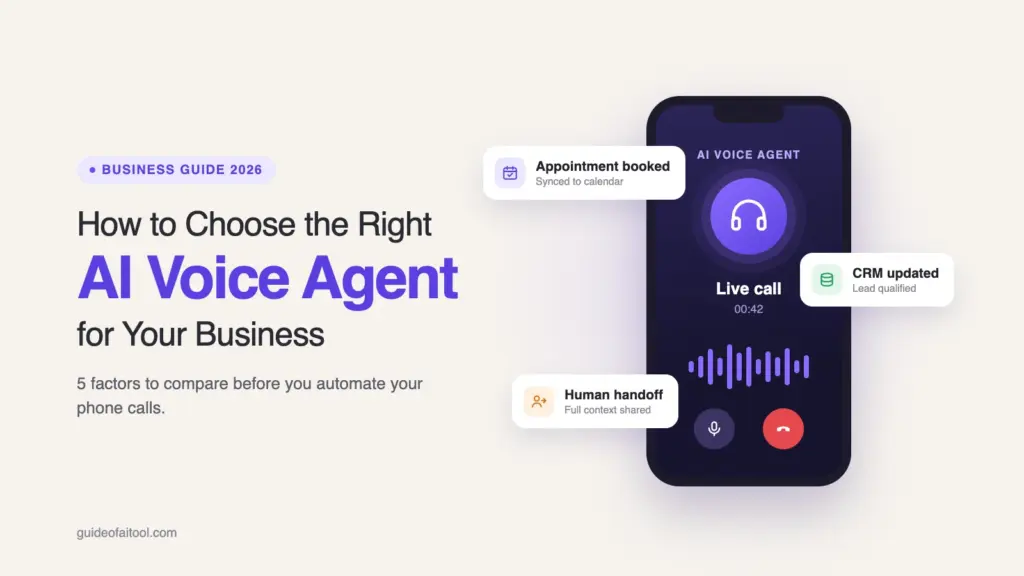
Even after your standard business hours end, your operations never have to go offline. An AI voice agent reacts to, initiates, and manages phone calls in human language. It can process dozens of customer calls, book appointments in your CRM, and support sales conversions.
That’s why more than 78% of organizations are deploying automated voice agents to manage their calls.
But choosing the right voice agent is also equally important for you because you need a solution that fits your exact workflow.
By the end of this guide, you will learn how to evaluate these advanced software systems and be sure of your choice.
What Is an AI Voice Agent?
An AI voice agent is an intelligent conversational assistant that recognizes human speech, understands needs, and acts upon requests.
Unlike having customers go through rigid and lengthy menu structures, a voice agent listens, responds to users as humanly as possible, and acts swiftly. It can help you schedule appointments, reply to inquiries, and update client records.
Overall customer satisfaction with AI voice interactions has reached 72%.
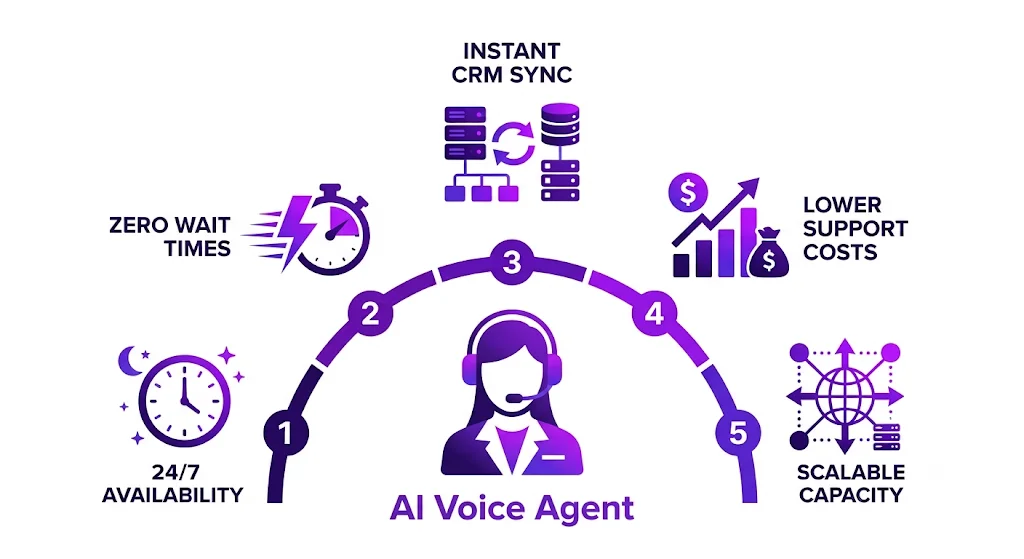
5 Evaluation Factors for Choosing the Right AI Voice Agent
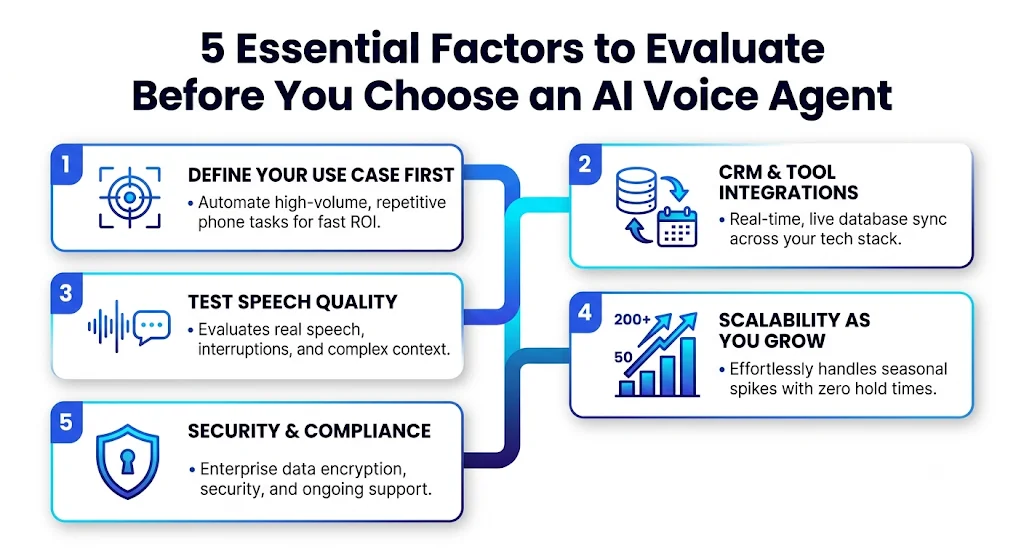
Choosing the right AI voice platform is going to be one of the biggest decisions you have taken so far. So, rather than getting lost in endless feature lists, focus on these five core factors so you select a tool that drives real business growth.
1. Define Your Use Case First
As you consider all the AI voice technologies out there, define your pain points first.
- Are you overloaded by inbound support calls?
- Are you struggling to keep up with appointment bookings?
- Are you missing after-hours sales leads?
The fastest way to see your ROI is to automate those operations that take too much time and are repetitive, not complex ones. For a business, lead qualification is as important as lead generation. An AI voice agent seamlessly asks screening questions and filters high-intent prospects before routing them to you.
Suppose you own a busy boutique dental clinic. Your front-desk staff spends hours every morning handling calls, but many are just inquiring about basic details like opening hours or insurance coverage. In this scenario, a voice AI agent can handle the routine questions, qualify new patient inquiries, and book appointments automatically.
2. Check CRM and Tool Integrations
In many industry workflows, agents are connected to external data feeds, such as AI-powered news APIs to pull real-time market updates, breaking industry information, or contextual data during live caller interactions.
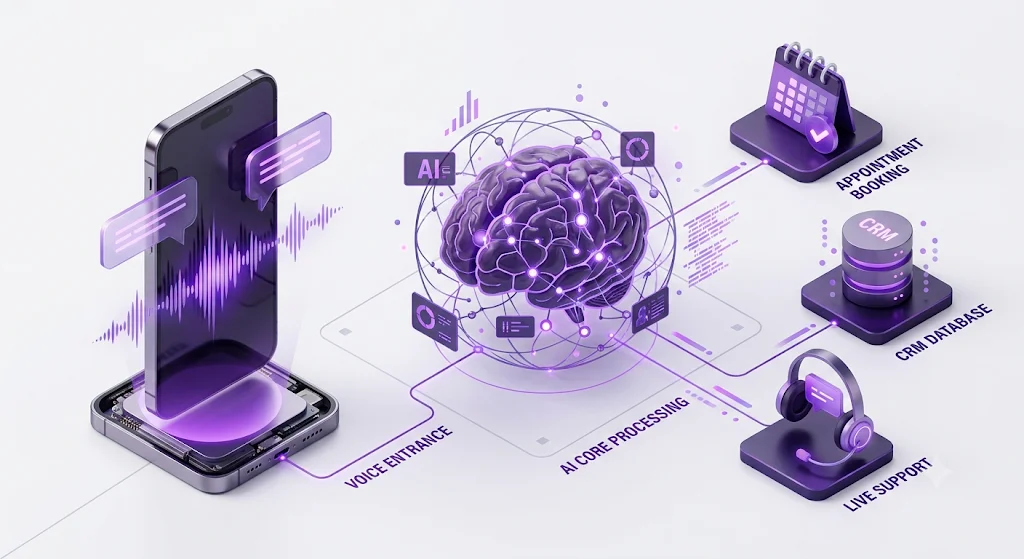
A voice assistant is only as valuable as the software systems it connects to. It could be a CRM, a helpdesk ticketing system, or even an online appointment scheduling platform.
The voice assistant must be able to read and update your CRM platform, helpdesk, and calendar in real time. So, select accordingly.
For example, you run a growing SaaS startup or field service business. A long-time customer calls after hours to reschedule their quarterly consultation. Instead of placing them on hold or forcing them to wait until morning, your voice agent reschedules the slot and updates the record.
Live tool synchronization helps you deliver an automated and instant service during conversations while keeping an updated database.
3. Test Conversation Quality With Real Speech
Don’t judge a software program based solely on a sales demo. Such demos usually run smoothly because the speaker sticks to a predetermined script. However, real life is more complicated.
Test how well the voice agent handles unpredictable situations that may arise from callers.
Consider running an e-commerce brand. It’s obvious that you get a lot of calls during a major holiday rush. On such a day, a customer may call you to track a late delivery, but mid-conversation, they interrupt to ask about your refund policy.
A weak voice agent may glitch or reset its script. But a superior agent will smoothly answer the refund question, hold the context, and guide the caller back to checking their tracking number.
If an AI assistant freezes when a caller cuts in mid-sentence, it breaks trust instantly and hurts your brand’s reputation. It should manage unexpected interruptions, background noise, or sudden topic changes well, without losing context.
4. Consider Scalability as You Grow
While choosing a voice agent, plan for long-term growth and seasonal spikes. In two years, your business may look different. So, your voice agent must be flexible enough to scale alongside it.
Make sure the platform can easily expand during busy periods without necessitating complete changes to your entire system.
Picture this: You run a seasonal landscaping business. During the spring rush, your call volume jumps from 50 calls to 200 calls per day. Your voice platform should effortlessly handle this 4x call spike with zero hold times or dropped calls.
You need a solution that flexes with your business cycles so you never lose revenue or miss customer inquiries during high-demand periods.
5. Prioritize Security, Compliance, and Ongoing Support
Working with voice data means protecting your clients’ information. Secure data handling protects you from regulatory fines.
If you operate in regulated industries like healthcare, legal services, or finance, you must verify that the voice agent complies with relevant data security frameworks.
Suppose you have a financial advisory firm or legal practice. When clients call in with sensitive personal details, your AI voice should encrypt every call transcript and enforce enterprise-grade guardrails. This enables you to safely automate initial intake calls and keep your business fully compliant.
It is important to deal with vendors who provide excellent ongoing customer support. Voice automation solutions have to be tuned for performance purposes on a constant basis.
Pro Tip: Avoid choosing an AI voice platform that forces you into a pre-built template or asks you to adapt your workflows to match their software. Always look for a platform that allows customization according to your business needs. If you want to learn about the ‘Best Open Source AI Models with Apache 2.0 License in 2026‘, take a look at our complete guide.
Why Choosing the Right Voice Agent Is Important
| Key Decision Factor | Generic Voice Agent | Purpose-Built AI Voice Agent | Impact on Your Business |
|---|---|---|---|
| Caller Experience | High delay (2-4 seconds) causes awkward silences and robotic conversations. | Sub-second latency (<1 second) enables natural, fluid back-and-forth dialogue. | Higher customer satisfaction (72%) and professional brand perception. |
| Call Execution | Only reads back basic pre-fetched text or simple scripted answers. | Performs complex live actions (calendar booking, payment processing, CRM updates). | Saves you hours of manual data entry every single day. |
| Handling Interruptions | Gets confused or resets when a caller cuts in or changes the topic. | Manages real-time barge-ins smoothly while keeping full conversation context. | Prevents caller frustration and abandoned phone calls. |
| Human Handoff | Cold transfers callers to a human staff member with zero background context. | Transfers calls along with the live transcript, summary, and caller history. | Eliminates customer repetition and cuts average handle times by 40%. |
| System Reliability | Higher risk of AI hallucinations, off-script tangents, or broken call flows. | Enterprise guardrails keep conversations accurate, secure, and on-track. | Protects your company’s reputation and guarantees regulatory compliance. |
When you select a voice platform built for enterprise communication, you eliminate friction for both your team and your customers.
The right AI voice agent perfectly tackles key sources of business friction. For example, Murf is built for fast and natural interactions, even during high-volume call spikes. Powered by the ultra low-latency TTS API, Falcon, the agent knows when to speak, pause, or listen. It solves major operational challenges through:
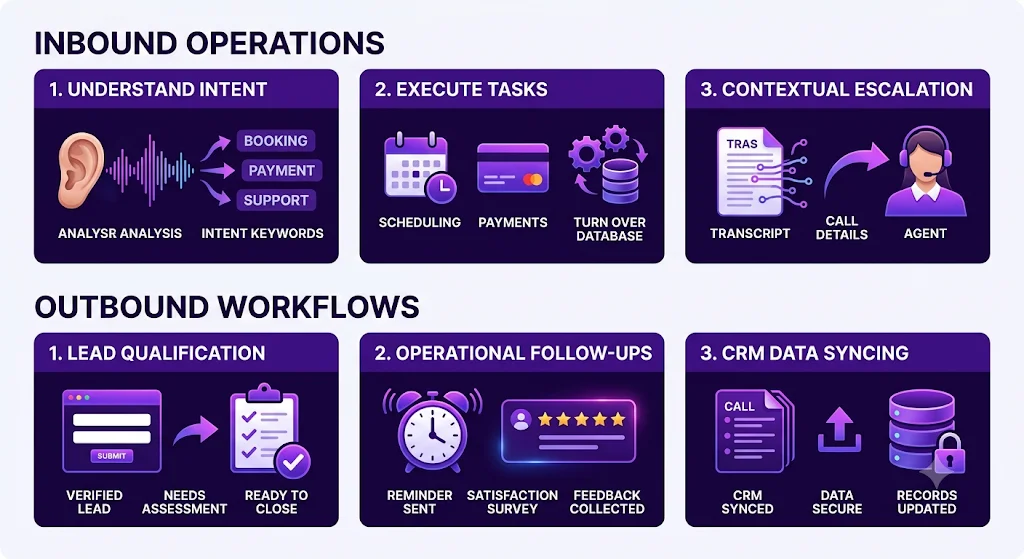
- Mid-Call Function Calling: Takes real-time actions during conversations, such as booking calendar slots, updating CRM, or processing payments. Instead of just reciting static text scripts, the agent acts.
- 24/7 Sales & Support: Resolves routine support tickets, qualifies incoming sales leads, and captures buying signals around the clock.
- Contextual Handover: When a call needs human help, it routes the call immediately along with the context, transcripts, and call recordings. Customers never have to repeat themselves because the platform made the escalation smooth.
Enterprise AI voice agents like this reduce average call handling times by up to 40% by automating routine mid-call tasks.
Key Takeaways
Main considerations to guide your decision:
- An AI voice agent will ensure that your operations are running nonstop, answering questions, and acquiring leads beyond regular office hours too.
- More than 78% of growing companies are using automated voice technologies, leading to year-by-year installation growth in production.
- AI voice operators are able to handle both inbound and proactive outbound calls.
- A correct voice agent can integrate seamlessly into your current CRM, scheduling solutions, and helpdesks.
- A rapid ROI starts with automating your most frequent and routine phone calls and not the most complicated tasks.
- Purpose-designed voice solutions provide instant responses, do not include any hallucinations, and enable human handling for complex problems.
- Choosing a flexible voice platform for business makes it possible for you to expand the call volume during your busy periods.
Choose the Right AI Voice Agent for Business Growth
Selecting the most suitable voice agent for your business depends on merging your needs and business goals with the purpose-designed voice platform. Automating your high-frequency calling processes eliminates waiting time and optimizes your business operations even outside regular business hours.
With an AI voice platform that offers millisecond response times, real-time database management, and smart human escalation processes, you can achieve business success. The correct approach to evaluation will help you convert your phone calls into a growth driver.
Frequently Asked Questions
How Do I Know if My Business Is Ready for an AI Voice Agent?
You are prepared for an AI voice agent if your business takes much of its time responding to repetitive questions, losing leads outside working hours, or failing to cope with spikes in calls. Automating these high-frequency routine phone tasks delivers the fastest return on investment without disrupting your core business operations.
Can an AI Voice Agent Connect With My Existing Business Tools?
An AI voice agent integrates smoothly with your CRM, calendar, and ticketing systems. These agents can immediately access the data in a customer’s record and make changes during the call.
What Happens if a Caller Asks Something the Voice Agent Cannot Answer?
The system makes use of contextual transfer to send the caller to a human staff member. The complete transcript of the conversation is also sent to the human operator.

Sapna Ghodasara is the founder of Guide of AI Tool, where she writes in depth reviews of AI tools for marketers, creators and businesses. Her reviews focus on what matters before you pay for a tool: real use cases, honest pros and cons, pricing, and how well it fits into an everyday workflow.
Sapna is the cofounder of SEOMagicLab. That mix of technical training and daily marketing work lets her judge AI tools from two angles: how well the technology actually performs and whether it delivers real value for the people using it.