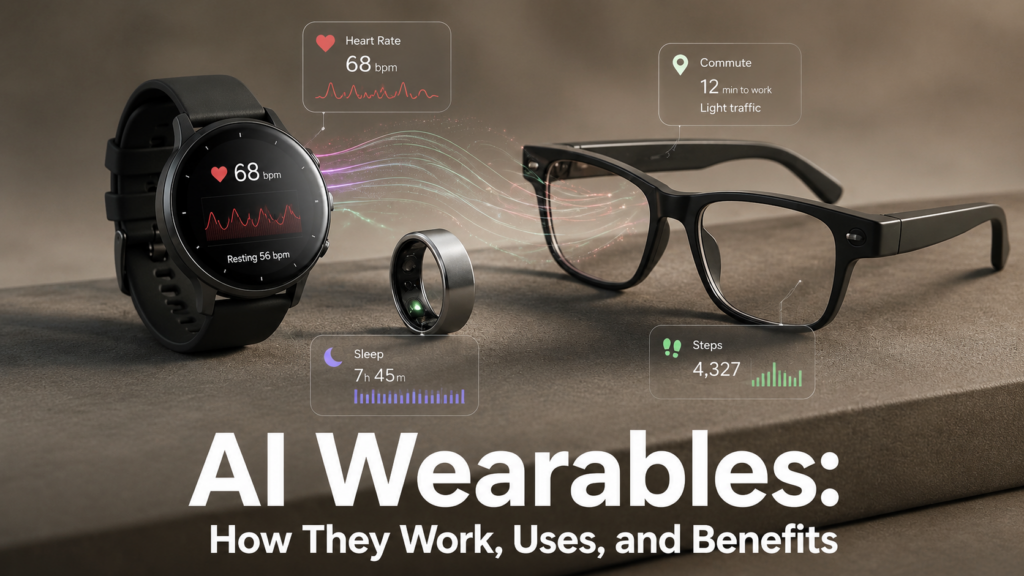
AI is not only used as an AI tool or as software. And it is very possible that you are already using AI in any device you use daily. Yes, most of the devices that we use physically without using a computer or mobile are also equipped with AI technology.
Things like smartwatches, fitness bands, smart rings, smart glasses, and even AI-powered headphones can now do more than collect basic information.
These devices have sensors gathering physical data, processors that move data from other parts, and machine learning that recognises patterns and makes predictions. A smartwatch, for example, can track your heart rate, sleep, movement, and activity and then identify patterns that a simple tracker might miss.
In this article, let’s understand AI wearables in great detail and figure out how they work and what the benefits of using them are.
What Is an AI Wearable?
An AI wearable is a device designed to be worn on the body that combines sensors with artificial intelligence.
The sensors gather information such as movement, heart rate, sleep, sound, temperature, or other signals. Software then processes that information to identify patterns and produce an output.
For instance, a traditional fitness band might record how many hours you slept. A more advanced wearable can compare your sleep with previous nights, activity levels, and other measurements to provide a broader interpretation.
How Does an AI Wearable Work?
There is a surprising amount of technology packed into something as small as a ring or smartwatch.
Sensors Gather Signals
Everything begins with data.
Depending on the product, sensors can monitor physical movement, heart activity, sleep, temperature, location, sound, or other measurements.
The wearable can collect this information repeatedly throughout the day, creating a much larger picture than a person could build manually.
Algorithms Find Patterns
The collected information becomes useful only after it is interpreted.
AI models can compare current readings with previous data and look for patterns. A change in activity, for example, might mean something completely different depending on a person’s normal routine.
This is where machine learning becomes important. Rather than treating every measurement separately, AI can examine several signals together.
The Device Turns Analysis Into Action
The final step is giving the user something useful. The wearable can actually alert the user and say it is time to recover after intense activity. It can let the wearer know that there is an unusual reading, provide a reminder, or answer a spoken request.
Where Does the AI Actually Run?
Some wearables perform certain tasks directly on the device. Others send information to cloud servers where more powerful computing systems process it. Many modern products use both approaches.
On-device processing is useful when a response needs to happen quickly or when keeping information on the device is preferable.
Cloud processing can provide access to greater computing resources and more complex models, although it may require an internet connection and raises additional questions about data handling.
A hybrid setup can combine the two. An AI wearable might deal with immediate tasks locally while using cloud computing for more complicated analysis.
Uses of AI Wearables
The interesting part of wearable AI is not the hardware itself. It is what the technology can do with the information it collects.
Understanding Health Trends
Wearables can continuously monitor things such as activity, heart rate, sleep, and other physiological measurements. Looking at these readings over time can reveal patterns that are easy to overlook when measurements are taken only occasionally.
Some devices can also flag unusual readings or changes. These alerts can be useful, although they should not be treated as a substitute for professional medical evaluation. The source material also notes that consumer devices can differ from clinical equipment in accuracy.
Making Workouts More Personal
Workouts don’t have to be boring and chaotic after using an AI wearable. A wearable can consider previous activity, training load, and recovery data when generating insights.
Users can understand when to increase their effort and when recovery may be more appropriate.
Improving Sleep Awareness
Sleep is another area where wearable AI can be useful.
A device can monitor sleep-related measurements over multiple nights and help users see whether their routine is changing.
The real value is not necessarily one night’s score. It is the longer-term pattern.
Offering Hands-Free Help
Smart glasses, earbuds, and similar devices are making AI assistants less dependent on screens.
A person can potentially ask a question, receive information, interact with digital services, or access contextual assistance without taking out a phone.
This makes wearable AI particularly interesting for situations where looking at a screen is inconvenient.
Supporting Accessibility
Wearable technology can also help people interact with their surroundings in different ways.
AI-powered hearing devices, smart glasses, captioning systems, and other assistive technologies can support communication and independence.
Helping Workers Stay Safer
Wearable AI is not limited to consumer products.
Factories, construction sites, warehouses, and other workplaces can use intelligent wearable technology to support training, monitor potential hazards, detect fatigue, or provide workers with instructions.
In these environments, the wearable becomes another layer of assistance rather than simply another personal gadget.
Advantages of AI Wearables
AI understands the context, and that is the biggest reason you should be using one. A normal device might tell you what happened, but AI can attempt to explain what that information means in relation to other information.
More Personalized Information
AI can work with an individual’s historical data rather than relying entirely on generic recommendations. So, the device can identify patterns that are specific to the user.
Information Without Constant Phone Use
Wearables can deliver alerts, information, and assistance without requiring a smartphone to be in the user’s hand.
Continuous Feedback
Because the device stays with the user, it can collect information throughout normal activities instead of relying on occasional manual input.
Early Awareness
AI systems can identify changes or unusual patterns and bring them to the user’s attention. This can be particularly useful when the change is difficult to notice personally.
Accessibility
Wearable AI can make information and communication more accessible by providing alternative ways to hear, see, understand, or interact with digital information.
The Problems With AI Wearables
The technology sounds impressive, but there are reasons to remain cautious.
The Data Is Not Always Perfect
AI cannot produce reliable conclusions from unreliable measurements. Sensor accuracy varies between devices, and consumer wearables are not necessarily equivalent to medical equipment.
The source also notes that recommendations can be affected by the quality of the underlying data.
Privacy Becomes More Important
A wearable can know a lot about its user. It may collect information about health, movement, sleep, location, voice, and daily habits. That makes privacy policies worth checking before buying a device.
Users should know where their information goes, how long it is retained, and whether it is shared with other services.
Battery Remains a Practical Problem
The more sensors and processing a device uses, the more demanding it can become on the battery.
A wearable that constantly needs charging can quickly become inconvenient.
Too Many Notifications
An intelligent device can also become annoying if it constantly interrupts the user.
If every unusual reading generates an alert, people may eventually stop paying attention.
Good wearable AI needs to know not only what to tell the user but also when it is worth interrupting them.
AI Scores Are Not Absolute Truth
Readiness scores, recovery scores, sleep scores, and similar measurements can be useful ways of summarizing complex data.
But they are still interpretations.
Treating a single number as a definitive description of your health or performance can lead to poor decisions.
Things To Look For Before Buying An AI Wearable
Before buying an AI wearable, you have to look for the best features. It does not necessarily mean you have to buy the most expensive one.
If you mainly want sleep tracking, a device built around sleep and recovery may make more sense than paying extra for health features you will never use.
If exercise is your priority, look for reliable activity and training measurements.
If hands-free assistance is the main attraction, smart glasses or audio wearables may be more relevant than a traditional smartwatch.
There are several practical factors worth checking:
- Sensor quality: The quality should be good.
- Battery life: Have a long battery life.
- Software: Should be easy to understand.
- Compatibility: It should be compatible with your devices.
- Privacy: Personal data should be handled nicely.
- Subscriptions: You must be able to afford the subscription.
- Comfort: Should be comfortable enough to be worn daily.
FAQs
What are AI wearable devices?
AI wearable devices are body-worn gadgets that use sensors and AI to collect data, recognize patterns, and provide personalized insights or assistance.
What is meant by wearables?
Wearables are electronic devices designed to be worn on the body, such as smartwatches, smart rings, smart glasses, and fitness trackers.
What are the top 5 wearable devices?
The top 5 wearable devices are smartwatches, smart rings, smart glasses, smart earbuds, and fitness trackers
What are the best AI wearables in 2026?
Some notable AI wearables include Ray-Ban Meta smart glasses, Oura Ring 5, Google Pixel Watch 5, Even Realities G2, and Samsung Galaxy Ring.