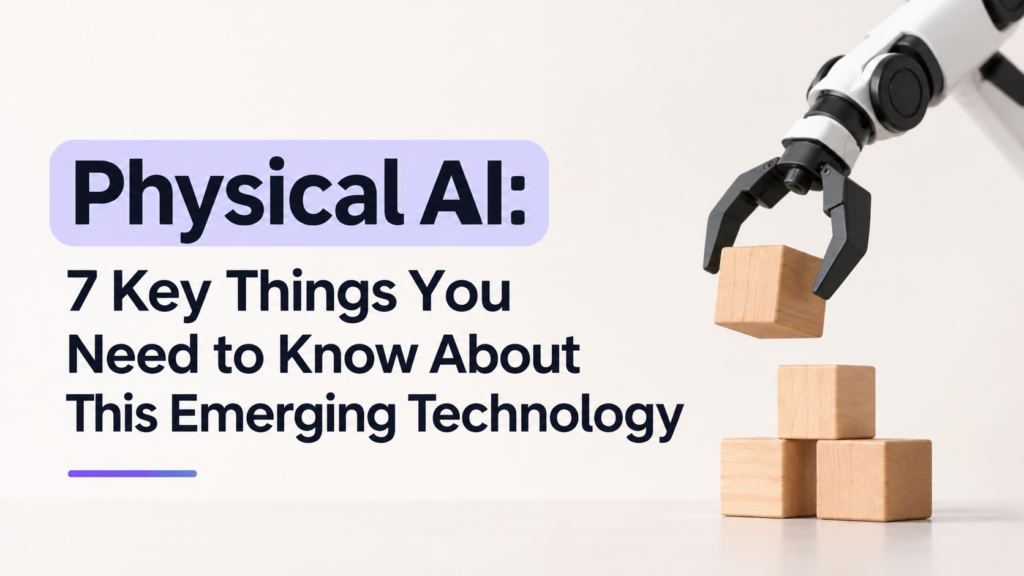
If I say the word ‘AI’, what comes to your mind? ChatGPT, an AI video editor, any popular internet AI trend, probably. Well, if I tell you that AI has moved beyond that and is not limited to computer screens? Would you believe me? You have to believe this because Physical AI is an emerging AI trend that lets machines perceive and understand their surroundings.
It is interesting to consider the possibility of a robot learning how to manipulate objects, move objects, and navigate unknown spaces in a completely independent and unguided way.
However, it is important to note that although Physical AI and Robotics both involve physical systems, there are subtle but significant differences. Physical AI combines machine learning, computer vision, sensing, and the ability to interact with unpredictable environments. Let us take a look at the key things to know about Physical AI and how it works.
What is Physical AI?
Physical AI is essentially AI that can interact with physical environments. This is similar to traditional AI; however, it interacts with the physical world. Traditional AI processes information, whereas Physical AI uses this information to complete physical actions.
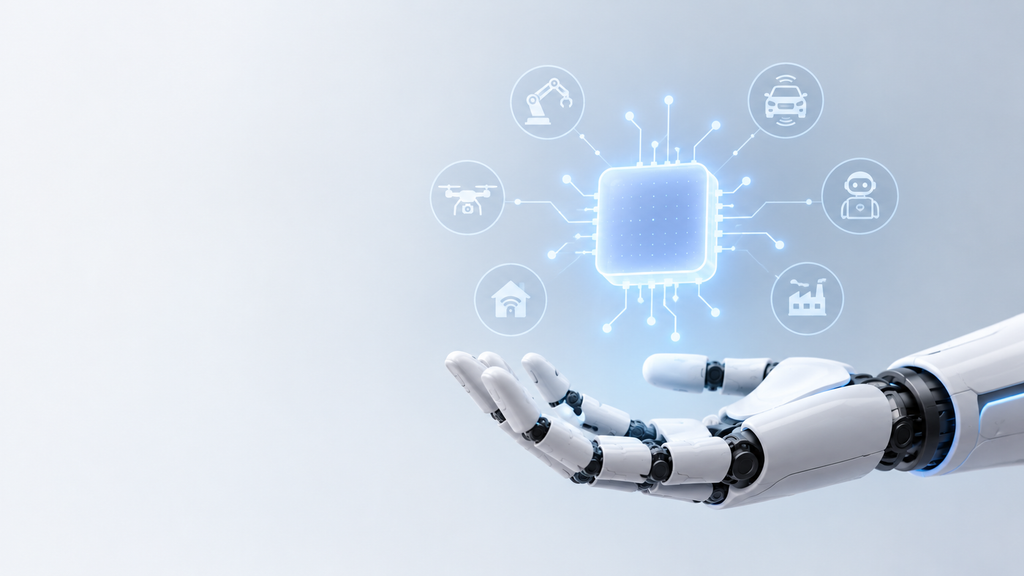
Physical AI can be implemented in many different types of machines. It can be seen in:
Manufacturing
Manipulating items, quality checking, and handling materials.
Autonomous Vehicles
Driving down roads and adapting to changing road conditions.
Drones
Inspecting buildings, monitoring crops, and navigating different environments.
Warehouses
Transporting goods, sorting packages, and moving stock.
Service Robots
Cleaning, delivering items, providing healthcare, and completing domestic tasks.
How does Physical AI work?
Physical AI uses a perception-action cycle to act on information in the environment. While traditional software takes in information and produces a digital output, Physical AI must consider the physical environment surrounding a machine in order to decide on actions to perform.
These steps are:
Perception
Using cameras, sensors, and other input devices, the robot can perceive the environment. It can detect items (packaging), people, shelving, obstructions, and pathways.
Understanding
The AI model analyses the information and understands what is happening. The package the robot needs to take, where it is, and whether there are any obstructions can be determined.
Decisions
The robot will then decide how to best perform the action. The best path to take, positioning of robotic arms, and how much force to apply to pick up a package may be decided.
Action
Instructions are sent to the control systems within the robot. Motors and actuators within the machine will move parts of the robot to act.
Learning
New information is gathered once the action has been completed. If the package has fallen, or there is an obstruction, the system can alter its next move. This loop will continue throughout the task.
It may not be learning new information every time. In some systems, information is used to change the robot’s actions in a short time frame. In others, information gathered from previous actions can be used to improve models.
Technologies That Have Made Physical AI Possible
Machine learning allows systems to identify patterns, identify objects and obstructions, predict movement, and make decisions within the environment. Computer vision analyses visual information, allowing the robot to identify people, vehicles, signs, distances, and spatial relationships. Sensors gather information. Cameras give visual information.
Distance information is given by LiDAR; objects and movement can be detected using radar. Ultrasonic sensors give distances, touch sensors detect contact/pressure, and an inertial measurement unit detects acceleration and orientation.
Sensor fusion uses all of these inputs to give a reliable picture of the environment. Foundation models allow adaptation to tasks, and vision language action models allow visual understanding, commands and actions to be linked. A robot may be able to identify a red mug, understand that it should move it, and do so with no pre-programmed instruction.
Bodies are provided by Robotics, with robotic arms, wheels, legs, joints, and grippers. Actuators with motors, hydraulic systems, and pneumatic systems convert signals from control systems into physical movement. Edge AI means that information is processed locally, improving response times.
GPUs and hardware enable model and sensor data processing. Simulation and digital twin technology allow people to train machines and environments in a less costly, quicker, and low risk way. This allows machines to perceive, understand, make decisions, and perform actions within the real world.
Real-World Applications of Physical AI
Physical AI has many applications in different industries. It is already being applied in many businesses.
Manufacturing and Automation
Robots can be used in manufacturing to perform many tasks, including welding, painting, packaging goods, and assembly. However, if sudden changes occur in a manufacturing environment, regular robots may struggle. Physical AI can be incorporated within these systems to improve adaptation to changing conditions. For example, robots with AI can identify different parts, adjust grips, and assemble in real time.
Other examples include:
- Detecting faulty products in production
- Handling a variety of item shapes and sizes
- Checking damage to machines
- Working alongside humans
- Changing production based on changing conditions
Healthcare and Medical Robotics
AI robots can be used in surgery to allow for very precise movements. Robots can also be used to help patients with rehabilitation, mobility, and transporting medical supplies. However, medical robots must be very strictly tested and monitored by humans. AI surgical tools cannot replace trained surgeons.
Examples include:
- Assisting in delicate procedures
- Assisting in rehabilitation
- Assisting elderly people with everyday tasks
- Transporting medicines and equipment
- Completing repetitive tasks for healthcare professionals
Autonomous transport
Autonomous vehicles are a clear example. They have cameras, LiDAR, radar, and AI to understand their environment and make decisions. Autonomous vehicles must be able to understand traffic, detect people, follow signs, and re-route if an obstruction occurs. This application of Physical AI could greatly increase efficiency in transport and reduce errors made by drivers. However, it is difficult to safely drive a vehicle in unpredictable conditions.
Examples include
- Autonomous cars/robot taxis
- Autonomous delivery vehicles
- Autonomous trucks
- Smart traffic management
- Autonomous public transport
Warehousing and Logistics
With many items being processed in warehouses, machines in this environment can be very intelligent. Physical AI can be used in robots to identify packages, move around, and manipulate products in a warehouse with little assistance.
Other examples include
- Organising and sorting stock.
- Picking/packing items.
- Moving items around.
- Managing traffic in the warehouse.
- Checking stock and locating misplaced items.
Agriculture
Physical AI can be very useful in agriculture. Many tasks within agriculture require close monitoring. AI machines can allow farmers to monitor crops, detect plant disease, and complete tasks with greater accuracy.
Examples include:
- Autonomous tractors and tools
- Robotic picking of fruit and vegetables
- Detecting and removing weeds with AI
- Using drones to monitor crops
- Very accurate watering and pesticide application
Construction and Infrastructure
As construction sites are constantly changing, with people, vehicles, and materials moving around, Physical AI can be very useful in completing construction tasks within changing environments. AI robots can also be used to inspect bridges, tunnels, and piping, which may be difficult or dangerous for humans to access.
Examples include
- Autonomous construction machinery
- Robotic assistants for bricklaying and transporting materials
- Automated inspections
- Monitoring buildings
- Identifying safety issues and damage
Everyday Tasks
Robots in the home can be very useful. Common domestic robots (such as vacuum cleaners) tend to be able to complete only a few specific tasks. With more advanced AI, robots can identify different items in the home, follow commands, and adapt to new situations.
For example, a robot could be able to identify objects on the floor, pick them up, and put them away.
Other examples include:
- Cleaning and tidying rooms
- Assisting elderly people with everyday tasks
- Transporting items in the home
- Preparing simple foods
- Assisting people with mobility issues
Benefits of Physical AI
There are many benefits of implementing Physical AI within businesses, industries, and everyday life. Below are some key benefits.
Increased Automation
Physical AI can allow for more complex automation. AI powered systems can be given a greater ability to understand their environment and adapt to changing conditions in comparison to traditional automated systems. Therefore, automation can be effectively applied in environments where traditional robots struggle.
Increased accuracy
As sensor data is continuously analysed, AI driven machines can adapt effectively during physical tasks. For example, in a robotic arm, visual and touch data can be used to adjust grip strength for fragile objects. This can allow for more consistency in tasks requiring precision, such as manufacturing, inspection, etc.
Improved safety in workplaces
Physical AI can mean less exposure to dangerous environments for people. Robots can be used to inspect dangerous environments in industries, manipulate heavy materials, and complete certain tasks in environments that may be unsafe for humans.
Intelligent perception systems can allow robots to detect people nearby and adjust their movements accordingly. Nevertheless, simply having AI does not guarantee that a robot will be safe. Careful consideration must be given to safety design and testing.
Increased productivity and Efficiency
Physical AI allows machines to perform tasks continuously and adapt to changes in operations with little manual input.
In warehouses, autonomous robots can assist with moving stock, allowing humans to perform more complex tasks. Businesses may experience increased efficiency, less time lost, and improved resource management.
Ability to Adapt to Changing Environments
It can adapt to situations it has not been specifically programmed to complete. If a standard robot encounters an obstruction in its expected path, it may come to a halt. However, if an AI powered robot encounters an obstruction, it may be able to identify the obstruction and calculate an alternate route. This ability to adapt could mean that robots can be used in more complex environments.
Support in labour-intensive industries
In industries such as agriculture, construction, manufacturing and logistics, physically demanding tasks can be common. Physical AI could therefore be very useful in overcoming many of these issues as it can take on physically demanding, repetitive and dangerous tasks. It may also help businesses in overcoming staff shortages in certain roles.
Challenges and Limitations of Physical AI
Despite the potential of Physical AI, there are many challenges to overcome. While it may be relatively simple to create an AI that can give accurate answers, creating a machine that can complete physical tasks safely in an unpredictable environment is extremely challenging. Below are some of the main limitations of Physical AI.
Cost to create and implement
Physical AI requires more than AI software. Businesses will require physical machines, sensors, actuators, computing hardware, maintenance systems, and specific infrastructure. Creating and testing these systems can be expensive, especially in complex environments. Small businesses may struggle with the high start-up cost.
Not enough training data
In order to allow AI models to perform tasks, large amounts of data are required. However, it can be very difficult to get physical interaction data. It may be necessary for robots to repeat the same movement in hundreds or thousands of instances in order to manipulate different objects, surfaces, and environments. Even after this, they may struggle with situations that they have not previously experienced. Difficult to understand physics in real-life environments. Real-life environments can be unpredictable.
Slippery objects, slippery surfaces, breaking of materials, and unexpected changes in environments can occur. Robots may perform well in a controlled testing environment, but struggle in real-life environments such as factories and warehouses. Understanding physics such as gravity, friction, balancing, and forces, and understanding how objects move is very challenging for developers of Physical AI systems.
Safety concerns
If a decision is incorrectly made by a Physical AI system, damage can occur. For example, if a robot misidentifies a person as an object it can push out of the way, serious harm may be caused. Similarly, if an autonomous vehicle makes an incorrect interpretation of road conditions, it could endanger passengers and pedestrians. Strict safety precautions, testing methods, emergency actions, and human oversight must be put in place before systems are deployed.
Concerns around privacy, security and ethics
Physical AI systems often contain cameras, microphones, and other sensors. If they are being used in homes, hospitals, workplaces, es or public spaces, there are concerns around data privacy and surveillance.
Future of Physical AI
Physical AI is still being developed. However, many developments in technology mean it is becoming very practical. One key development is the increasing use of foundation models in robots. This means machines can understand visual information, natural language commands, and different situations in physical environments without being programmed to complete specific tasks.
Another key development is the use of simulation and synthetic data. Rather than relying solely on real-life training, robots can be exposed to a variety of different scenarios in simulated environments. Companies are also developing humanoid robots that can complete a variety of tasks in human like forms.
These could be used in factories, warehouses, and other human designed environments. However, it is important to consider what these machines can currently do, and what we may expect from them in the future. Just because a robot can impressively perform a few tasks, it doesn’t necessarily mean it can reliably complete everyday tasks on its own.
Improvements in hardware, affordability, safety, and general intelligence in Physical AI must be made in order for it to be common in industries. In the near future, we may see more specific applications of Physical AI; however, general purpose robots may not be very common for some time.
FAQs
Is Physical AI the same as Robotics?
No. Robotics refers to the general design, creation, and running of physical machines. Physical AI incorporates AI with robotics, allowing machines to understand their environment, make decisions, and adapt.
What is the difference between Physical AI and Embodied AI?
Physical AI is commonly used in industries to refer to systems incorporating AI models, robotics, sensors, and physical machines. Embodied AI is commonly used in academic research to refer to intelligence gained by interacting with an environment.
How is Physical AI trained?
Physical AI can be trained in a variety of ways, including supervised learning, reinforcement learning, and imitation learning. Real-life interaction data, synthetic data, and simulated environments are all used to train and assess the behaviours of Physical AI systems.
Is Physical AI currently being used?
Yes. AI-enabled robots, autonomous mobile robots, inspection systems, and autonomous vehicles are being developed and used in many settings. However, the level of autonomy varies greatly. Many systems are still restricted to specific environments and require human oversight.
Will Physical AI Replace Human Workers?
Physical AI may only replace repetitive, physically demanding, and dangerous tasks. Humans will not be completely replaced.
Conclusion
Physical AI is a significant development within AI. It allows digital intelligence to be applied in the physical world. By combining AI models, sensing, robotics, and advanced computing, machines can understand their environments and react to changing conditions.
Beyond just humanoid robots, many industries can benefit from more intelligent Physical AI systems. These include manufacturing, healthcare, transport, agriculture, construction, and logistics. However, there are still many difficulties to overcome. Due to high costs, limited training data, hardware limitations, safety concerns, and unpredictable environments, it is challenging to widely implement Physical AI.
Currently, Physical AI should be considered an emerging technology with great potential. However, as AI models and robotics improve, the way machines interact with the physical world may change significantly.

Sapna Ghodasara is the founder of Guide of AI Tool, where she writes in depth reviews of AI tools for marketers, creators and businesses. Her reviews focus on what matters before you pay for a tool: real use cases, honest pros and cons, pricing, and how well it fits into an everyday workflow.
Sapna is the cofounder of SEOMagicLab. That mix of technical training and daily marketing work lets her judge AI tools from two angles: how well the technology actually performs and whether it delivers real value for the people using it.