For most of film history, VFX meant a compositor, a render farm, and a timeline measured in weeks. AI filmmaking has compressed that timeline down to a conversation: describe what a shot needs, and the effect happens directly on the footage. What’s actually changed isn’t just speed, it’s that VFX has split into a handful of distinct, well-defined operations, each solvable on its own terms rather than requiring a full production pipeline every time.
The operations that make up modern AI VFX
Four capabilities cover most of what AI filmmaking now handles natively:
Inpaint and outpaint. Masking a region of a frame and repainting just that part, or pushing the canvas past its original edges, widening a shot, changing the aspect ratio, or filling in what the camera never captured. It’s a targeted, localized edit, not a full regeneration of the shot.
Relight and recolor. Changing the time of day, swapping the key light, or applying a film-grade color grade after the footage already exists, no reshoot, no regenerating the clip from scratch. This is one of the more common fixes on a real production: a shot lit for the wrong mood, or exposure that doesn’t quite match the scene around it.
Prop swap and clean plates. Replacing an object in a scene, or wiping it out entirely for a clean background, the same work a VFX artist would do by hand in a compositor, without opening one.
Motion control and scene extension. Driving full-body choreography, fight scenes, or fine motion like fingertip gestures from a reference clip, then extending a shot to whatever length the edit actually needs.
Invideo Agent handles visual effects with AI across all four of these as distinct operations rather than one generic “add VFX” request, each one gets applied on its own terms, using the input and approach it actually calls for, instead of being forced through the same generation step as everything else.
Where this shows up in practice
A few concrete examples make the shift clearer than the feature list alone:
- Relighting a shot that’s already cut. Rather than reshooting or regenerating, a scene can be relit directly, changing mood, fixing bad exposure, or matching lighting across shots from different setups, without a compositing pipeline or a second unit day.
- Swapping backgrounds in product ads. A product shot in a studio can move into a lifestyle setting, keeping shadows, lighting, and motion natural, without a reshoot or a manual VFX pass, useful for producing many ad variants around the same product.
- Removing green screens. Keying, edge refinement, and clean composites happen through conversation rather than manual rotoscoping, describe what needs to come out, and the result is a clean composite, not a rough key that still needs cleanup.
Two ways to work
There are two paths to the same VFX outcome in AI filmmaking. The manual path is closer to a traditional tool: pick a VFX feature, upload the asset, describe the intended output in a prompt, and generate. It works well for a single, isolated fix.
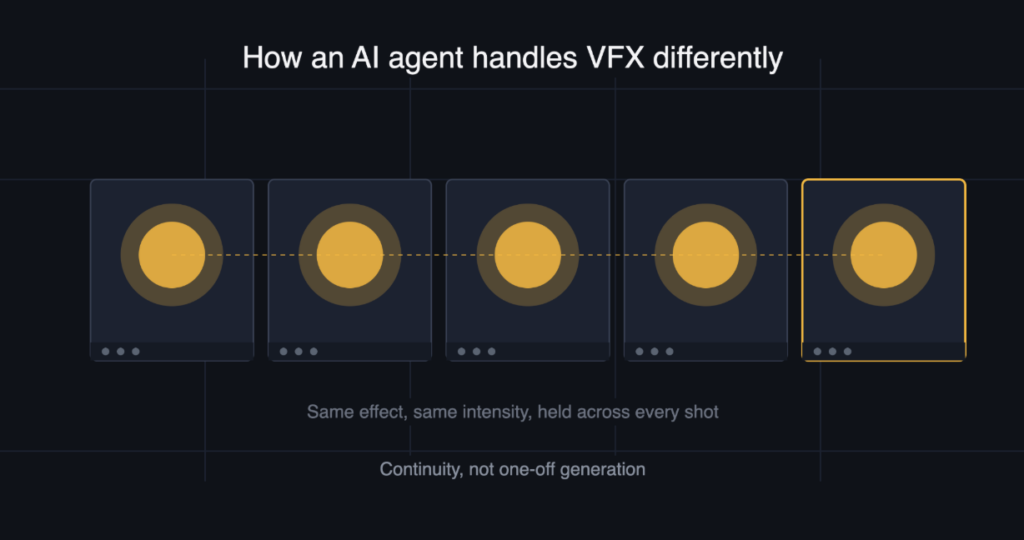
The agentic path works differently: describe the shot, and the agent selects the right underlying model and applies the effect itself. It’s iterative rather than one-shot, give it a reference video or tell it what to change, and it keeps adjusting until the shot matches. The real advantage shows up on anything beyond a single isolated shot: because the agent works from the same project context each time, an effect established on one shot, a specific grade, a lighting choice, a prop swap, carries forward automatically to the next shot that needs the same treatment.
Why consistency is the real shift
The four operations above aren’t just separate features, they’re separate failure modes when handled inconsistently across a sequence. A relight applied once and not carried forward means a scene’s mood shifts unintentionally between cuts. A prop swap that isn’t tracked across every shot it appears in means the same element resurfaces somewhere it shouldn’t. A motion-control pass driven from a reference clip needs to stay consistent with the character and blocking already established in the scene, not treated as its own isolated generation.
This is the same underlying shift happening across AI filmmaking more broadly, in character consistency, in product consistency, and now in VFX: the meaningful change isn’t that AI can generate a convincing effect once. It’s that a project can hold an effect’s rules in memory and apply them the same way across an entire sequence, without re-describing them every time.
What this means in practice
- Different VFX needs call for different inputs. Relighting and prop removal work on footage that already exists; motion control needs a reference clip to drive accurately.
- Editing doesn’t mean regenerating. A shot with a lighting or color problem doesn’t need to be rebuilt from scratch, several of these operations are designed to work directly on footage you already have.
- The manual and agentic paths solve different problems. A single isolated fix suits the manual workflow; a sequence that needs the same treatment held consistent across several shots benefits from the agentic one.
FAQ

Sapna Ghodasara is the founder of Guide of AI Tool, where she writes in depth reviews of AI tools for marketers, creators and businesses. Her reviews focus on what matters before you pay for a tool: real use cases, honest pros and cons, pricing, and how well it fits into an everyday workflow.
Sapna is the cofounder of SEOMagicLab. That mix of technical training and daily marketing work lets her judge AI tools from two angles: how well the technology actually performs and whether it delivers real value for the people using it.