Hypotenuse AI
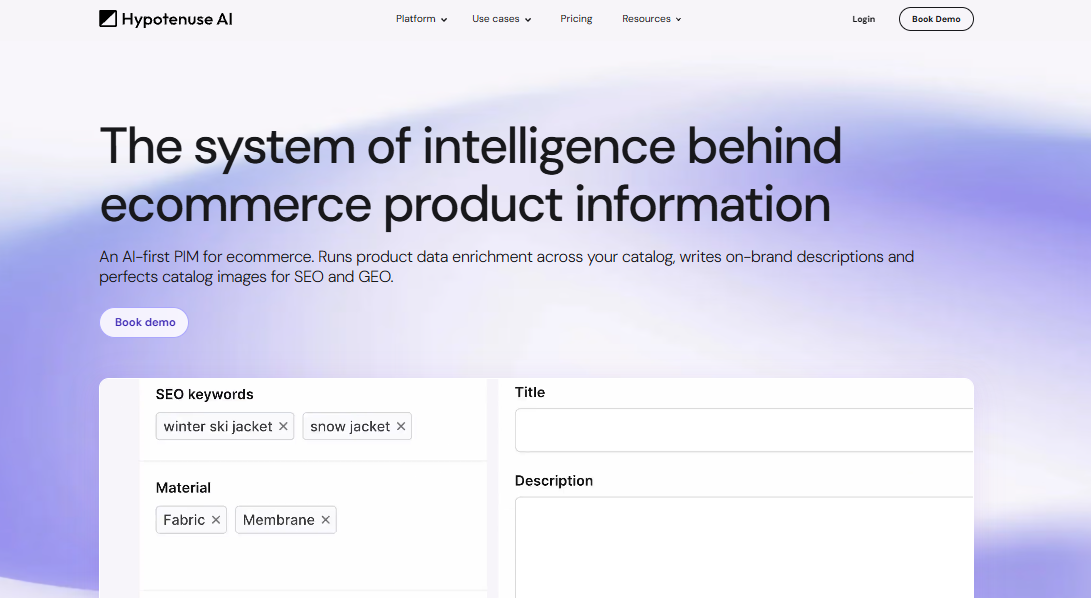
AI-native Operating System for Enterprise E-commerce Companies
E-commerce businesses have thousands of products that need descriptions, specifications, tags, images, and SEO content. Managing that is not easy.
Hypotenuse AI is known for e-commerce content, product data, and large-scale catalog management. In this guide, let’s see how the tool works and where it performs well.
What is Hypotenuse AI?
Hypotenuse AI is created for e-commerce brands, retailers, and agencies for the purpose of producing e-commerce content.
Hypotenuse AI can generate descriptions and titles for posting products. It can help improve the quality and appearance of existing product images. It can help optimize content for SEO as well.
Businesses that manage large catalogs find Hypotenuse AI very useful. Large batches of products can be processed rather than posting them individually.
Features Of Hypotenuse AI
Hypotenuse AI focuses mainly on automating e-commerce content and product catalog management.
AI Product Agents
Its AI agents handle different parts of the product workflow:
- Product Data Agent: Cleans, organizes, and enriches incomplete product information.
- Content Agent: Generates product titles, descriptions, and bullet points for different marketplaces.
- Image Agent: Helps resize, enhance, crop, and edit product images in bulk.
- SEO Agent: Suggests improvements to product content and metadata for search visibility.
Bulk Content Generation
Hypotenuse AI can process large product catalogs at once. Users can import product data, generate descriptions, fill missing attributes, and create standardized product tags in bulk.
Shopify Integration
Shopify users can connect their store to Hypotenuse AI, generate product content, and sync updates back to their catalog without manually copying each description.
Other AI Tools
Hypotenuse AI also includes an article writer, HypoChat for general AI assistance, and HypoArt for generating marketing visuals.
Use Cases Of Hypotenuse AI
Hypotenuse AI is most useful when content needs to be created across a large product catalog. Some of its practical use cases include:
Creating product descriptions
Generate descriptions, titles, and bullet points for large numbers of products.
Enriching product data
Fill missing specifications, attributes, and other product details.
Updating large catalogs
Rewrite or refresh existing product content in bulk.
Managing Shopify content
Generate and update product copy without manually moving content between platforms.
Optimizing product pages
Improve product copy and metadata for search visibility.
Preparing product images
Resize, crop, enhance, and standardize product images at scale.
Supporting marketing teams
Create blog content, marketing copy, and visuals alongside product content.
What We Like About Hypotenuse AI
Built for e-commerce
The focus is on product catalogs, making it perfect for e-commerce businesses.
Bulk automation
Helps in processing bulk content, which saves significant time.
Multiple tasks
Data enrichment, copy generation, image editing, and SEO tools are available in the same workflow.
Shopify integration
Shopify users can work with product content without relying entirely on manual transfers.
Useful for large catalogs
The platform becomes more valuable as the number of products and repetitive tasks increases.
What We Don't Like About Hypotenuse AI
Content still needs editing
It is not ready to publish content. You should review it first, as the descriptions can get a bit repetitive at times.
Long-form writing is less convincing
The longer the write ups, the more the content starts becoming similar and needs editing.
E-commerce pricing isn't transparent
The pricing cannot be compared, since Hypotenuse AI uses a custom pricing plan system.
Limited accessibility
The lack of a mobile app or browser extension may be inconvenient for some users.
Pricing Plans of Hypotenuse AI
The pricing plans of Hypotenuse AI are not explicitly mentioned and can only be known by requesting a custom quote. The platform is however, transparent about the features. These are the features of both plans, basic and enterprise.
Basic — Custom pricing
- Designed for e-commerce stores with fewer than 100 products
- 1 user seat
- 40+ languages
- Product description generator
- 20+ e-commerce content types
- Option to contact the team for additional seats or words
E-commerce Enterprise — Custom pricing
- Designed for large teams with complex workflows and compliance needs
- Custom user seats
- Product attribute enrichment
- Product tagging and categorization
- Product information and taxonomy management
- Bulk AI image editing
- Custom AI models
- AI checker for brand and channel guidelines
- Custom PIM/ERP integrations
- Team access controls
- Dedicated account manager and onboarding
FAQs About Hypotenuse AI
What is Hypotenuse AI?
Hypotenuse AI is an AI platform for creating and managing e-commerce content.
Does Hypotenuse AI work with Shopify?
Yes. Hypotenuse AI integrates with Shopify to help create and manage product content.
Does Hypotenuse AI create blog posts?
Yes. It includes AI writing tools for creating SEO-focused blog articles and other marketing content.
Is Hypotenuse AI good for large catalogs?
Yes. Its bulk content and product-data tools make it more suitable for businesses managing hundreds or thousands of products.
Is Hypotenuse AI free?
Hypotenuse AI offers a free trial.
Conclusion
The entire workflow of Hypotenuse AI is created around e-commerce. That is a big advantage and a big limitation as well. It is not just an AI writer but an AI writer focused on e-commerce. The limitation is that it is only focused on e-commerce. So, if you are going to use it for generating product descriptions and content around that topic, only then can it be of any use to you.
Hypotenuse AI is a stronger choice for high-volume e-commerce content than for businesses primarily looking for polished, long-form editorial content.