The traditional software development lifecycle is reaching an operational inflection point. For decades, engineering organizations scaled software delivery linearly: hiring more engineers, breaking teams into smaller squads, and layering on project managers to coordinate tickets and pull requests.
What Defines an Enterprise-Grade AI Software Factory?
Evaluating an AI software factory architecture requires examining technical capabilities beyond basic code generation:
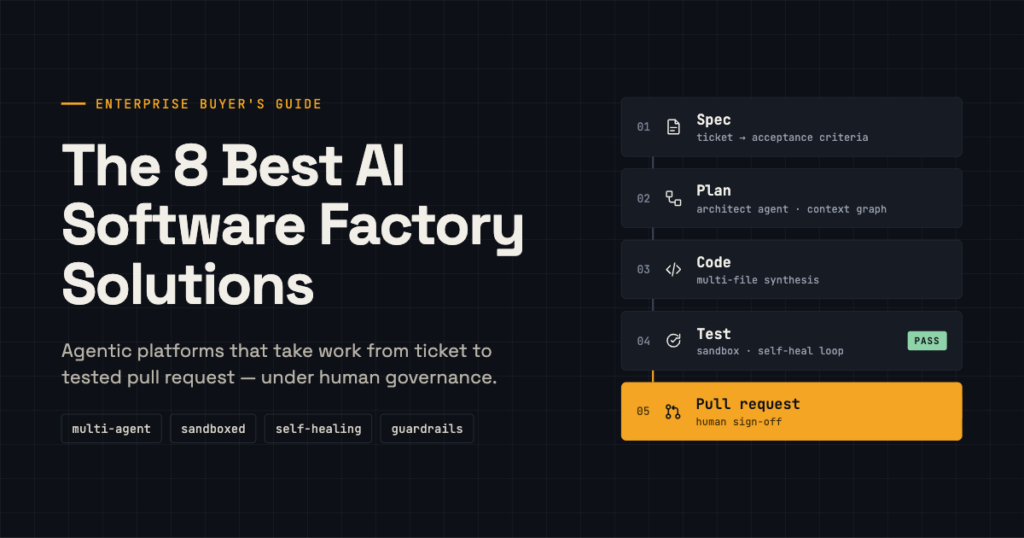
- Agentic PDLC & SDLC Orchestration: The capacity to coordinate specialized AI agents that handle distinct lifecycle roles, product scoping, architectural planning, code authoring, automated testing, and security auditing, under unified governance.
- Deterministic Context Assembly: Ingesting and assembling deep codebase context, architecture diagrams, internal APIs, and dependency graphs so agents build on accurate system logic rather than generic web patterns.
- Sandboxed Execution & Self-Healing Loops: Running generated code inside isolated virtual runtime environments where compilers, linters, and test runners execute automatically, allowing the agent to read stack traces, fix bugs, and iterate before human inspection.
- Enterprise Guardrails & Human-in-the-Loop Governance: Enforcing strict organizational policies, security baselines, and review checkpoints ensuring human engineers retain architectural control and sign-off authority.
The 8 Best AI Software Factory Solutions
1. Overcut
Overcut delivers an AI software factory platform engineered to automate end-to-end software delivery across the Product Development Lifecycle (PDLC) and Software Development Lifecycle (SDLC). Operating as a self-improving software factory, Overcut orchestrates
specialized AI agents that take engineering tasks from initial specification and ticket definition through to architectural planning, multi-file code synthesis, automated testing, and pull request generation.
For modern engineering teams and enterprise technology organizations, Overcut solves the scaling bottleneck by replacing fragmented manual developer tasks with structured, multi-agent execution loops. The platform’s agentic architecture does not merely write isolated functions; it coordinates
context across repositories, validates code against internal architecture standards, and continuously executes automated verification checks.
- Self-Improving Factory Architecture: Continuously learns from past project builds, code reviews, and developer feedback loops to optimize future execution accuracy.
- Deterministic Code & Context Reasoning: Maps organizational dependencies, repository structures, and API conventions to produce clean, production-grade code changes.
- Automated Quality & Verification Gates: Evaluates synthesized code against automated test suites, linters, and architectural constraints prior to human sign-off.
2. Cognition (Devin)
Cognition provides Devin, an autonomous AI software engineering platform designed to operate alongside development teams as an autonomous teammate. Devin is built with an integrated execution environment featuring its own shell, code editor, browser, and compute sandbox. This architecture allows
the agent to ingest a task, search documentation, write code, execute builds, inspect console errors, and iteratively troubleshoot bugs without requiring constant human guidance.
In an enterprise delivery model, Devin functions as a dedicated autonomous worker for targeted engineering projects. Engineering teams assign Devin backlog tickets, legacy codebase migrations, package upgrades, and complex bug investigations.
- Iterative Problem Solving: Observes compilation failures, test runs, and browser rendering errors to autonomously debug and refine its implementation.
- Broad Task Capability: Capable of handling complex migrations, external API integrations, dependency updates, and automated bug resolutions.
- Transparent Execution Logging: Provides real-time step-by-step progress tracking, detailing command execution, file modifications, and planning logic.
3. Factory
Factory delivers an enterprise-focused AI software factory platform built around autonomous systems known as Droids. Designed to automate routine and complex engineering workflows across the development lifecycle, Factory provides pre-configured, purpose-built Droids tailored for specific software
engineering functions. These include Droids specialized in code review, unit test generation, security vulnerability remediation, and feature implementation directly within corporate code repositories.
For enterprise engineering leadership, Factory provides a standardized framework to scale development capacity while maintaining consistent engineering quality. Factory integrates with GitHub, GitLab, and enterprise issue trackers like Jira, allowing teams to trigger Droids automatically based on
issue assignments or pull request events.
- Specialized Autonomous Droids: Purpose-built agentic bots configured for dedicated tasks, including feature construction, code review, and automated testing.
- Seamless Issue Tracker Integration: Automatically reads and acts on user stories and bug tickets from Jira, Linear, and GitHub Issues.
- Automated Remediation Workflows: Scans codebases for known vulnerabilities and technical debt, creating complete pull requests with verified fixes.
4. Poolside
Poolside develops advanced foundational AI models and developer platforms built specifically for software engineering and software delivery automation. Backed by proprietary models trained directly on deep execution traces and codebase reasoning, Poolside’s platform is designed to power enterprise
software delivery from internal infrastructure. It emphasizes deep contextual understanding of massive, proprietary corporate codebases that generic consumer-oriented LLMs struggle to navigate.
For large enterprises with extensive proprietary software assets, Poolside provides the foundational intelligence required to run an internal software factory. The platform supports on-premises and private cloud deployment models, ensuring that proprietary source code, internal frameworks, and
business logic remain within enterprise security perimeters.
- Engineering-Native Foundation Models: Custom-trained foundational models optimized specifically for code syntax, execution flow, and structural reasoning.
- Private Cloud and On-Premises Hosting: Flexible enterprise deployment options that protect proprietary IP within private corporate infrastructure.
- Deep Multi-Repo Contextualization: Synthesizes and indexes relationships across large-scale enterprise repositories and internal shared libraries.
5. Magic
Magic develops frontier AI systems and foundation models engineered specifically to act as automated software engineers. Built with ultra-large context windows capable of processing millions of tokens in a single inference pass, Magic’s architecture allows an AI to ingest an enterprise’s entire
codebase, complete documentation sets, and historical commit histories simultaneously. This massive context envelope eliminates the context fragmentation common in traditional vector-based RAG architectures.
Within an enterprise software factory setup, Magic provides deep system-level comprehension across interconnected microservices and legacy frameworks. By holding the complete architectural blueprint in active memory, Magic’s engineering agents plan and implement multi-file modifications with an
understanding of global side effects.
- Ultra-Large Context Window: Processes millions of tokens simultaneously, allowing complete enterprise repositories to be evaluated in a single pass.
- End-to-End Task Completion: Capable of synthesizing features, refactoring data models, and generating supporting test suites from high-level prompts.
- Synthetic Data & Model Research: Leverages proprietary training paradigms focused on code synthesis, algorithmic planning, and verification logic.
6. Augment Code
Augment Code provides an enterprise-grade AI software development platform built around an intelligent codebase indexing and contextual awareness engine. Designed to scale with large, fast-moving engineering organizations, Augment constructs a continuously updated semantic and dependency graph of
an organization’s code repositories, internal APIs, and developer conventions. This ensures that every line of code synthesized by the platform aligns with internal team practices.
In the context of scaling software delivery, Augment acts as an accelerator that bridges the gap between individual developers and the broader codebase. By providing accurate contextual awareness across millions of lines of code, Augment enables engineers to implement features in unfamiliar
codebases without spending hours tracing dependencies.
- Real-Time Codebase Intelligence: Continuously analyzes and indexes repository changes, maintaining an up-to-date dependency and architecture graph.
- Cross-Repository Awareness: Traces APIs, types, and schemas across multiple distributed repositories to prevent cross-service interface mismatches.
- High-Accuracy Code Generation: Generates idiomatic code matching internal design patterns, established libraries, and corporate conventions.
7. Sweep AI
Sweep AI provides an open-source, developer-first AI software engineer that automates bug fixes, small feature implementations, and code maintenance directly from GitHub issues. When an issue is logged, Sweep analyzes the description, plans the necessary file modifications, writes the code, and
generates a pull request ready for human review. If continuous integration checks fail, Sweep reads the build logs and pushes commits to fix the errors automatically.
For engineering teams seeking a modular, extensible software factory framework, Sweep offers an accessible entry point that embeds directly into existing Git workflows. Teams use Sweep to automate the resolution of routine maintenance tasks, documentation updates, and technical debt.
- Issue-to-Pull-Request Automation: Turns bug reports and feature requests into pull requests containing complete code changes and explanations.
- Self-Correcting CI Feedback Loops: Automatically parses GitHub Actions and CI run logs to identify and fix failing tests or linting errors.
- Granular Task Scoping: Best suited for clearing routine backlog items, fixing edge-case bugs, and maintaining internal documentation.
8. GitStart
GitStart provides an engineering acceleration platform that combines AI agent orchestration with a human-in-the-loop verification network to deliver completed pull requests from backlog tickets. Operating under a “Software Delivery as a Service” model, GitStart ingests tasks directly from Jira,
Linear, or GitHub, assigns them to AI-driven generation pipelines, and verifies the resulting code through a distributed community of senior engineers before submitting the pull request.
This hybrid approach makes GitStart an effective solution for enterprise teams that want to scale engineering output without taking on the review burden of managing raw AI outputs.
- Human-Verified PR Delivery: Blends automated multi-agent code generation with human code verification to ensure production-level code quality.
- Predictable Delivery SLA: Provides clear turnaround times for completed pull requests, operating like an elastic extension of the internal team.
- Risk-Free Code Integration: Ensures that incoming PRs pass all repository tests, adhere to styling guidelines, and introduce no regression bugs.
Step-by-Step Implementation Guide: Building an AI Software Factory
Transitioning an enterprise engineering department from manual task execution to an AI software factory model requires a structured, multi-phase operational strategy:
1. Standardize Architectural Context and Specifications
An AI software factory is only as reliable as the context it consumes. Before deploying autonomous agents, ensure your repositories have clean architectural documentation, explicit API contracts, and well-maintained OpenAPI or GraphQL schemas. Standardize your issue tracking by requiring clear
acceptance criteria, expected input/output behaviors, and designated boundary conditions in user stories. This eliminates ambiguity during agentic planning phases.
2. Configure Sandboxed Execution Environments
Never allow autonomous coding agents to execute code or run shell commands directly against production or local developer environments. Set up secure, containerized execution sandboxes (using Docker, Firecracker microVMs, or cloud runners) where agents can safely compile code, run migrations, and
execute test suites. Providing agents with direct access to compiler outputs, terminal logs, and test results allows them to self-correct failures before submitting code for human review.
3. Orchestrate End-to-End Workflows with Multi-Agent Systems
Implement an orchestration platform to link your issue management systems directly with your code repositories. Configure specialized agent workflows where an architectural agent first breaks down an issue into a technical plan, a coding agent implements the necessary multi-file changes, and a
testing agent authors the corresponding unit and integration tests. Automated gates ensure each step passes structural checks before moving to the next stage.
4. Implement Human-in-the-Loop Governance and Metrics
Establish clear boundaries for human review. Require senior engineering sign-off on all agent-generated pull requests, treating the AI factory as an elastic team of junior and mid-level engineers. Track core operational metrics, such as PR cycle time, test pass rates on first generation, lines of
code modified per ticket, and post-merge defect density. Use review comments and manual refactor patterns to continuously refine your factory’s prompts, context configurations, and architectural rules.
Frequently Asked Questions
What is the difference between an AI coding assistant and an AI software factory?
An AI coding assistant (like GitHub Copilot or Cursor) is an interactive tool embedded inside a developer’s IDE, designed to suggest lines of code or answer queries while a human programmer types. An AI software factory is a comprehensive platform that automates broader segments of the software
delivery lifecycle. It orchestrates autonomous multi-agent workflows that take an issue ticket, plan the architecture, edit multiple files across repositories, run tests in isolated sandboxes, and submit complete, production-ready pull requests with minimal human intervention.
Can an AI software factory handle complex, legacy enterprise codebases?
Yes, provided the platform incorporates sophisticated context-assembly mechanisms. Platforms like Overcut and Augment Code index repository dependencies, type systems, and historical patterns, allowing agents to understand how legacy modules interact with modern services. For massive enterprise
monoliths, platforms with ultra-large context windows (like Magic) or continuous semantic indexing are critical to ensure that changes do not introduce unintended side effects in distant parts of the system.
How do AI software factories prevent the accumulation of technical debt?
Unlike unguided LLM usage, which can produce inconsistent, fragmented code, an enterprise AI software factory operates under strict automated guardrails. By enforcing automated linting, type-checking, architectural pattern constraints, and mandatory unit/integration test generation within
sandboxed test runners, the factory ensures that generated code meets organizational quality baselines before it ever reaches a human reviewer.
Will AI software factories replace human software engineers?
No. AI software factories shift the role of the software engineer from manual code typing to architectural design, system specification, and quality governance. Human engineers act as factory directors: they define business requirements, review proposed system architectures, adjudicate edge cases,
and ensure alignment with strategic business goals. By automating repetitive boilerplate coding and routine backlog tasks, software factories allow engineering teams to focus on creative problem-solving and high-leverage architectural challenges.