Someone buying car insurance will need to submit an application, get the risk evaluated, receive a premium, and then finally get the insurance policy. In case an accident happens, a file is required to claim compensation.
An insurance company helps with the entire process, and AI insurance software makes this process faster. In this guide, you will get to know about the best 8 AI Insurance software options.
What is AI Insurance Software?
AI insurance software is a tool that improves efficiency within insurance businesses. It can be used to support various aspects of insurance, including customer acquisition, risk assessment, underwriting, issuing insurance, calculating pricing, claims processing, detecting fraudulent activity, managing documentation, and customer support.
Underwriting software is used to assess applications and determine any associated risks. Claims processing software uses documents and images of damage to claims to allow for quicker processing. Detection of fraudulent activity, extracting key data from documents, and answering insurance related questions are also features of AI Insurance Software. Solutions also exist to manage policies, calculate pricing, evaluate potential losses and manage insurance agent and broker workflows.
Popular examples of AI insurance solutions include: CoverGo, Duck Creek Technologies, Earnix, Shift Technology, Akur8, Gradient AI, Indico Data and Majesco. These platforms can be focused on one specific aspect of insurance or be combined to support many aspects of an insurance business. Although AI can increase efficiency by automating basic processes, handling vast quantities of information and producing useful recommendations, human oversight should still be considered to make complex and significant decisions.
CoverGo
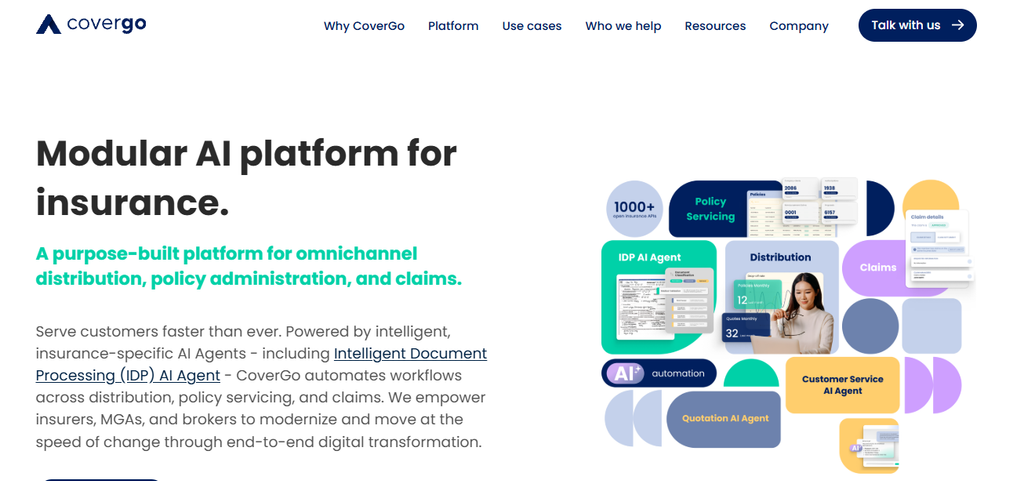
CoverGo is a platform designed to unify multiple processes within insurance businesses. The platform allows the creation of products, applications, and claims in one place. With AI in place, tasks such as document checking, information gathering, claim processing, and risk assessments can be made more efficient.
Using CoverGo, some parts of the application process can be automated. This means that manual document checks required by employees can be reduced. As well as this, there is a no-code product builder within the software, meaning that insurance companies can easily develop and update policies without requiring a large development team. This can be useful if an insurer wants to offer new products and improve customer service.
Duck Creek

Duck Creek provides solutions for automating policy, invoicing, claims handling and underwriting processes. This simplifies processes where information and documentation needs to be transferred across different departments within an insurance business. It links these processes together in one system, making it easier for staff to understand and complete processes in an efficient manner.
The AI features within the solution offer automation of processes, document handling, and informed decision making throughout the insurance process. Claims teams can create automated processes to manage information and move cases through the review process. Property and casualty insurers could greatly benefit from this solution by upgrading legacy systems, streamlining policy management, and providing a smoother customer experience.
Earnix
Earnix provides insights to insurers on what to charge customers for insurance. This decision can be complex depending on several factors. These include specific customer characteristics, risk, market trends, and expected claims.
Through AI, Machine learning, and data analytics, pricing teams are able to understand key factors to create improved models and also be able to alter prices to account for changes in customer behaviour and market trends. An insurance provider for car insurance could utilise these insights in order to identify high risk groups within their customers and alter prices accordingly. Overall, Earnix would be very useful for Insurers looking to make more informed decisions around pricing, understand risk better, and provide products to meet customer needs.
Shift
Shift Technology helps insurance companies deal with one of their biggest challenges: identifying fraudulent claims without slowing down genuine customers. Insurance providers receive thousands of claims, and checking each one manually can take a lot of time. Shift uses AI and machine learning to examine claim information, customer records, and other available data to identify unusual patterns that may indicate fraud.
For example, if a claim contains details that do not match previous records or shows suspicious patterns, the system can flag it for further investigation. This allows insurance teams to focus on cases that need closer attention instead of reviewing every claim in the same way. Shift also supports claims automation and other insurance decisions, helping companies reduce unnecessary investigations, manage risks, and process genuine claims more efficiently.
Akur8
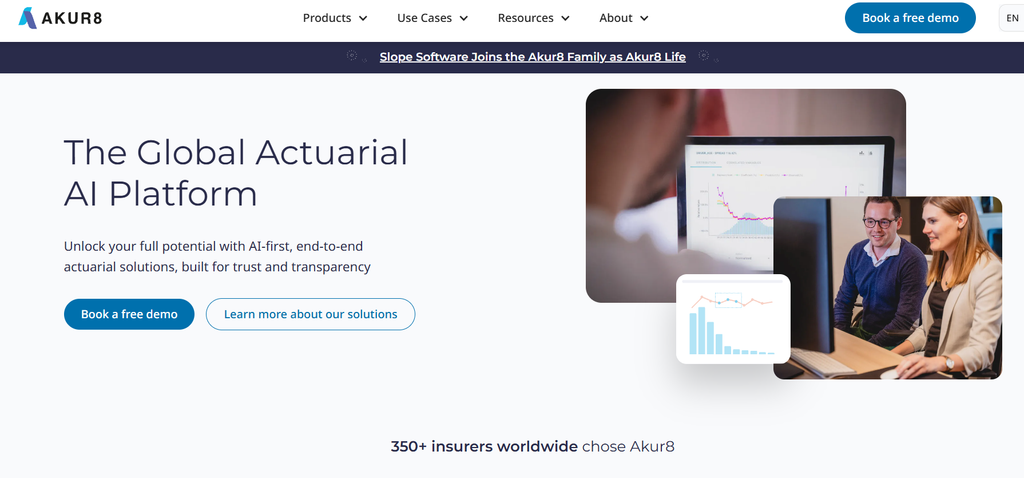
Akur8 is a tool that can help insurance companies create better pricing models. Pricing models are typically complex processes requiring actuaries and pricing teams to gather data, make different assumptions, and create models to determine customer pricing. By using machine learning within this process,
Akur8 allows pricing teams to achieve these models more efficiently. It helps insurance companies understand important risk factors, how these may impact claim costs, and ultimately create more accurate pricing. Auto pricing can be improved by using Akur8 to consider risk factors related to driving and how these should affect pricing. Akur8 would be useful for insurance pricing teams looking to save time on manually creating models and focus on improving pricing models.
Gradient AI

Gradient AI helps insurers make more informed decisions. Using AI models, it analyses vast amounts of data within insurance to highlight possible risk factors and claim outcomes. This allows insurers to predict if certain policies are likely to result in high claims, or identify instances which may need further attention.
Underwriters can therefore make more informed decisions on new applications, with greater understanding of potential costs. In claims management, Gradient AI allows identification of trends which may cause increased costs. Therefore, the solution is particularly useful within Property Casualty, Workers’ Compensation and Group Health markets. It means that risk can be better assessed, and claims costs managed.
Indico Data
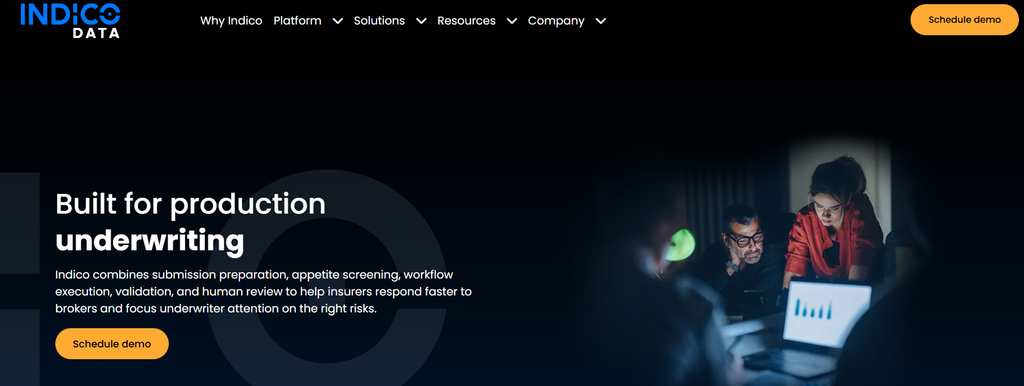
Indico Data helps insurance companies handle the large amount of paperwork involved in applications, underwriting, and claims processing. Insurance teams regularly receive information through emails, PDFs, spreadsheets, forms, and other documents. Going through all these files manually can slow down decisions and create unnecessary work.
Indico Data uses AI to read documents, extract important details, organize information, and move it into the right workflows. For example, when an insurance company receives a new application, the platform can identify important details, check whether required information is available, and prepare the submission for an underwriter to review. This means employees do not have to spend as much time searching through documents or entering information manually. Indico Data is a useful option for insurers looking to speed up document-heavy processes and give their teams more time to focus on important decisions.
Majesco
Majesco delivers a range of insurance software that insurers can benefit from in their daily handling of core tasks like policy administration, billing, claims, and underwriting. These functions are interdependent in an insurance company. A delay in one department impacts the overall business.
Majesco unifies these business operations via online insurance solutions and leverages AI and automation technologies to ease daily tasks. For example, carriers could utilize such technologies to gather policy details, automate segments of claims handling, and provide underwriting support. The AI powers of the software can also help the teams to analyze business data for identifying customers’ needs and uncover areas of improvement in the workflow.
FAQs
What is AI Insurance Software?
AI Insurance Software assists insurance providers in many of their core processes such as underwriting, claims, fraud, risk, and customer service through the use of artificial intelligence, machine learning, and automation.
How does AI help insurance companies?
AI enables insurance companies to deal with data at a much faster rate; conduct less manual work; uncover probable fraud; better understand risks; automate claims; and support clients.
What are the different types of AI Insurance Software?
Types of insurance software include AI driven underwriting software, claims processing and management software, fraud detection software, risk management software, document processing software, policy management software, insurance pricing software, and agency management software.
Which AI Insurance Software is best?
The most suitable software is determined by the needs of the company. For instance, CoverGo and Duck Creek Technologies enable policy and insurance management, Earnix and Akur8 are dedicated to insurance pricing, and Shift Technology is focused on insurance fraud detection.
Can AI automate insurance claims processing?
Yes. AI can pull data from claims documents, review photos of damage, calculate repair costs, verify policy information, and flag potential fraud. But any tricky issues will likely be reviewed by human eyes before being approved.
Can AI detect insurance fraud?
Yes. AI detects fraudulent activity by evaluating past claims, customer information, transactions, and abnormal patterns. It can also select cases for review by human experts.
Can AI Insurance Software help smaller insurance agencies?
Yes. Small insurance firms can equip themselves with artificial intelligence (AI) based systems to streamline contact management, automate requests, compile documents, generate quotes and facilitate client communication. The proper package will be based on your firm’s size, budget and needs.
Does AI replace insurance agents and underwriters?
Not completely. AI can automate basic and repetitive activities, carry out data analysis, and provide recommendations. It cannot replace insurance agents, underwriters, and claims professionals who deal with complex issues and critical decisions.
Conclusion
AI insurance software automates a number of things in insurance. An insurance provider can use AI insurance software to automate several processes like claims, underwriting, battling fraud, and more. The type of AI that they would use will depend on what they are looking to do. For example, some may want to look into how they use AI in underwriting, risk analysis, and pricing.

Sapna Ghodasara is the founder of Guide of AI Tool, where she writes in depth reviews of AI tools for marketers, creators and businesses. Her reviews focus on what matters before you pay for a tool: real use cases, honest pros and cons, pricing, and how well it fits into an everyday workflow.
Sapna is the cofounder of SEOMagicLab. That mix of technical training and daily marketing work lets her judge AI tools from two angles: how well the technology actually performs and whether it delivers real value for the people using it.