Every enterprise engineering organization now runs AI agents somewhere. Developers use coding agents in the IDE, a platform team has automated a few workflows, and someone is piloting an agent that resolves tickets. What most organizations do not yet have is a factory: a repeatable system where
agents and engineers work from the same context, follow the same standards, and move changes from intent to production under the same controls.
That gap explains why the “AI software factory” has become one of the most-discussed ideas in engineering leadership. The concept is simple, a production system where AI agents do much of the building while humans set direction and approve outcomes, but the implementations differ widely. Some
platforms focus on generating software from specifications, some on running agents inside a DevSecOps suite, and some on the platform layer that governs every agent regardless of where it runs.
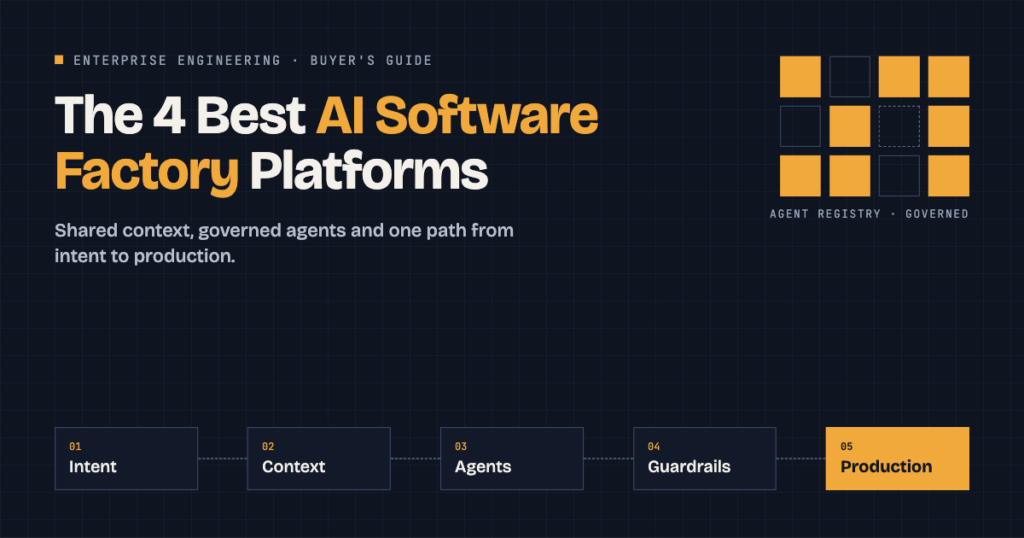
The 4 Best AI Software Factory Platforms for Enterprise Engineering
1. Port: Best AI Software Factory Platform
Most AI software factory products are built around a single agent or a single delivery pipeline. Port takes a different approach as an Agentic Engineering Platform: it provides the platform layer that lets an organization run many agents safely across the
entire software development lifecycle, regardless of which tools those agents use. Port describes five pillars that make this possible, a context lake, AI agents, workflows, governance, and an interface builder, and together they cover the parts of a factory that code-generation tools leave out.
The foundation is the context lake, Port’s unified engineering knowledge layer. It connects data from repositories, cloud resources, incidents, deployments, and more than 200 integrations into a continuously updated, queryable model of the software estate, with auto-discovery keeping it current.
Agents query it for owners, dependencies, standards, and health before they act, which reduces hallucinations and, according to Port’s own research, can cut AI token costs by around 80% by letting agents reason over structured context in a single query.
Port then manages agents as governed participants. Its registry catalogs homegrown and third-party agents, skills, and MCP servers with labels, permissions, and guardrails attached, and skills can be ingested automatically from Git so teams reuse logic instead of rebuilding it. Port does not lock
organizations into a single AI vendor: teams can use Claude Code, Cursor, their own LangGraph agents, or any MCP-compatible tool, while the Port MCP server exposes catalog context and workflows so those agents work from the same source of truth and guardrails as humans do.
Workflows turn that context into action. Teams can describe automated flows in natural language and Port builds them into working workflows, with steps that loop in people through Slack or Microsoft Teams for updates and approvals. Governance is built in rather than added later: approvals,
role-based access, dynamic permissions, scorecards, and audit trails apply to agents exactly as they do to engineers, and Port can sit atop AI gateways to connect budgets and model usage to the software catalog. Dashboards and notifications from the interface builder keep engineering leaders
informed about what agents are doing across the organization.
Key features:
- Context lake unifying 200+ integrations into a live model of the software estate
- Registry for homegrown and third-party agents, skills, and MCP servers
- Bring-your-own-agent support, including Claude Code, Cursor, and MCP clients
- Port MCP server exposing context and workflows to external agents
- Natural-language workflow creation with Slack and Teams approvals
- RBAC, dynamic permissions, approvals, and audit trails for agent actions
- Scorecards that track standards and service health
- Dashboards and notifications for visibility into agent activity
For enterprises that want every agent, from any vendor, to work from shared context and under consistent governance, Port provides the most complete foundation for an AI software factory.
2. 8090
8090 takes a build-centric approach with a product literally named Software Factory. Founded in January 2024 by Chamath Palihapitiya, who now serves as CEO, the company raised a $135 million Series A led by Salesforce Ventures in mid-2026 to scale the platform.
Software Factory brings people and AI agents into a single collaborative environment that connects business intent, requirements, architecture, work orders, code, testing, and production maintenance. The goal is to let organizations build highly customized software while giving leaders visibility,
accountability, and auditability from idea to deployment. 8090 focuses on industries where mistakes are costly, including healthcare, defense, manufacturing, financial services, energy, and government.
8090 is strongest for organizations building or rebuilding specific applications. Enterprises that want to govern many existing agents across an established engineering estate may pair it with a broader platform layer.
Key features:
- Collaborative workspace for people and AI agents
- Traceability from business intent to production maintenance
- Auditability for regulated environments
- Focus on custom enterprise software and modernization
8090 works best for regulated enterprises building or modernizing custom applications with AI.
3. Blitzy
Blitzy occupies a distinct position as a platform built for autonomous development at very large scale. It connects to repositories on GitHub, GitLab, or Azure DevOps, ingests codebases of up to 100 million lines, and produces a living technical specification that engineers review before any code
changes.
From there, thousands of specialized agents plan, generate, compile, and test code over extended periods, and Blitzy says it can autonomously generate up to 80% of the work on a project, delivered as pull requests. The company raised $200 million at a $1.4 billion valuation in May 2026, and its
use cases include legacy modernization projects such as COBOL to Java migrations.
Blitzy concentrates on producing large amounts of code for defined projects. Organizations will still need processes for reviewing its output and governing how its changes interact with the rest of their engineering estate.
Key features:
- Ingestion of codebases up to 100 million lines
- Living technical specification reviewed by engineers
- Thousands of specialized agents working asynchronously
- Pull-request delivery for large modernization projects
Blitzy works best for enterprises with large legacy modernization or feature programs.
4. GitLab Duo Agent Platform
GitLab Duo Agent Platform, generally available since January 2026, brings agents and multi-step flows into the GitLab DevSecOps platform. Agents work directly in issues, merge requests, pipelines, epics, and repositories, drawing on the full lifecycle context GitLab holds.
The platform includes foundational agents such as a Planner Agent and a Security Analyst Agent, along with built-in flows for turning issues into merge requests, reviewing code, fixing CI/CD pipelines, and migrating CI/CD configurations. Teams can build custom agents and share them through the AI
Catalog, and external agents such as Claude Code and Codex CLI can operate within GitLab’s governed environment. It is available on GitLab.com and self-managed instances for Premium and Ultimate customers, including options for self-hosted models.
Its context and governance are strongest inside GitLab. Organizations that run delivery across several source control, CI/CD, and cloud tools may need a platform that spans all of them.
Key features:
- Agents inside issues, merge requests, and pipelines
- Foundational agents and prebuilt flows
- AI Catalog for sharing custom agents
- Self-managed deployment and self-hosted model options
GitLab Duo Agent Platform works best for organizations standardized on GitLab for source control and delivery.
Why Governance Is the Missing Layer in Most AI Software Factories
The first wave of AI engineering tools focused on output: more code, faster. Enterprises quickly discovered that output was not the constraint. Three problems surface as soon as agents move beyond individual developers:
- Agents lack organizational context: a coding agent can read a repository, but it does not know who owns a service, which standards apply, what depends on it, or whether it is healthy. Without that context, agents produce changes that look correct and break things elsewhere.
- Nobody knows which agents exist or what they can do: homegrown agents, third-party agents, skills, and MCP servers multiply quickly across teams. Without a registry and permissions, platform and security teams cannot see or control them.
- Actions happen without the right approvals: when agents can provision infrastructure, merge code, or change production settings, enterprises need the same approvals, audit trails, and role-based access they require from engineers.
A true software factory solves all three. It gives agents a shared source of truth, manages them as governed participants, and routes their work through the same workflows and guardrails as human engineers.
Build or Buy an AI Software Factory?
Many enterprises start by assembling their own AI software factory from open source frameworks, internal tooling, and a handful of agents. That approach offers control, but it tends to recreate the same components every platform team eventually needs: a catalog of services and owners, a registry
of agents and permissions, workflow orchestration, approvals, and audit logging.
Building those pieces internally requires a dedicated team and ongoing maintenance, and the result often covers only the agents that team chose to support. Buying a platform layer shortens the path, especially when it works with the agents and tools developers already prefer rather than replacing
them.
A practical middle ground is to buy the foundation and build on top of it. Enterprises can adopt a platform that provides context, governance, and orchestration, then add their own agents, skills, and workflows that reflect how their organization builds software. That way, the parts that should be
consistent across every team are consistent, and the parts that make each organization unique stay under its own control.
FAQ
What is an AI software factory?
An AI software factory is a production system for software in which AI agents perform much of the planning, coding, testing, and operational work, while engineers define goals, set standards, and approve outcomes. It combines engineering context, agent orchestration, workflows, and governance so
agents can work reliably across the software development lifecycle.
How is an AI software factory different from an AI coding assistant?
A coding assistant helps an individual developer write code in an editor. An AI software factory coordinates many agents and people across the whole lifecycle, from planning to production, using shared context, standardized workflows, and enterprise governance so that agent work is consistent,
safe, and auditable.
Why do AI agents need engineering context?
Agents that only see code do not know who owns a service, what depends on it, which standards apply, or whether it is healthy. Platforms such as Port provide this context through a context lake, so agents make changes that fit the organization and avoid breaking related systems.
Can an AI software factory use agents from different vendors?
It depends on the platform. Some factories run only their own agents or work best inside one vendor’s ecosystem. Platform-layer approaches such as Port support bring-your-own-agent models, letting teams use tools like Claude Code, Cursor, or custom agents under the same governance.
How do enterprises govern AI agents in a software factory?
Governance includes a registry of agents and their permissions, role-based access to actions, approval steps for sensitive changes, scorecards that enforce standards, and audit trails of what each agent did. These controls let enterprises give agents real responsibilities without losing oversight.
Should an enterprise build or buy an AI software factory?
Most enterprises benefit from buying a platform foundation for context, governance, and orchestration, then building their own agents, skills, and workflows on top. Building everything internally is possible but requires significant ongoing investment and often limits which agents and tools can be
supported.