Choosing an AI video platform is about more than getting a clip that looks good in the demo reel. Here’s what actually holds up once you dig past the marketing.
I’ve got a client deliverable due, a product launch to promote, or a concept to pitch, and a full production crew usually isn’t in the budget. So I turn to AI video tools.
That part’s easy. The hard part is figuring out which platform is actually worth the subscription, because the space is crowded with tools that all claim to be the fastest, the most cinematic, and the most “everything in one place.”
Two names keep coming up in that conversation: Invideo and Higgsfield.
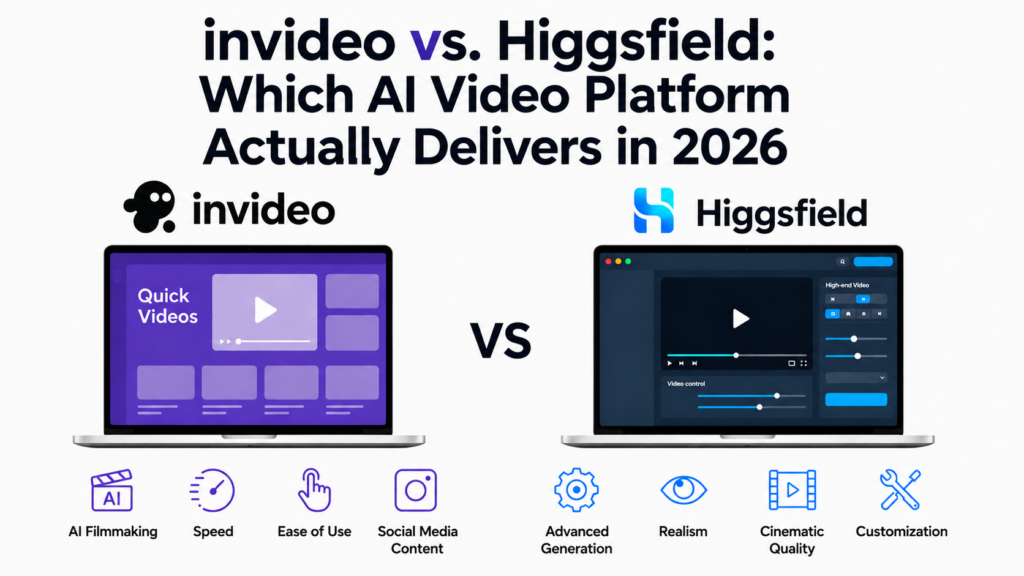
Comparing them isn’t really about which one makes a prettier single clip. Once you factor in what happens to a project across many shots, what the pricing actually costs once you account for iteration, and how much manual model-picking you’re expected to do yourself, the decision starts to look very different.
Invideo vs. Higgsfield: A Quick Overview
Higgsfield is an aggregator. Founded by ex-Google Brain engineers in 2023 and now valued at roughly $1.3 billion after a Series A extension, it bundles 15 to 50+ third-party models, Kling 3.0, Sora 2, Veo 3.1, Seedance 2.0, WAN 2.6, Nano Banana Pro, under one subscription, with 22 million registered users. It doesn’t build its own proprietary models; it gives you a single interface and a large model library to pick from manually.
Invideo Agent is built around an agent, not a model picker. Rather than choosing which of dozens of models suits a shot, you describe what you need, and invideo Agent routes each shot to whichever model actually fits, a distinction that matters a lot in AI filmmaking, where a project usually needs several different kinds of shots, not just one. And with the recent launch of invideo Agent Two, that agent now comes with persistent long-term memory, a full crew of specialized sub-agents, and the ability to read and understand any file you throw at it, none of which Higgsfield’s model-aggregator approach is built to do.
Pricing: What the Sticker Price Doesn’t Tell You
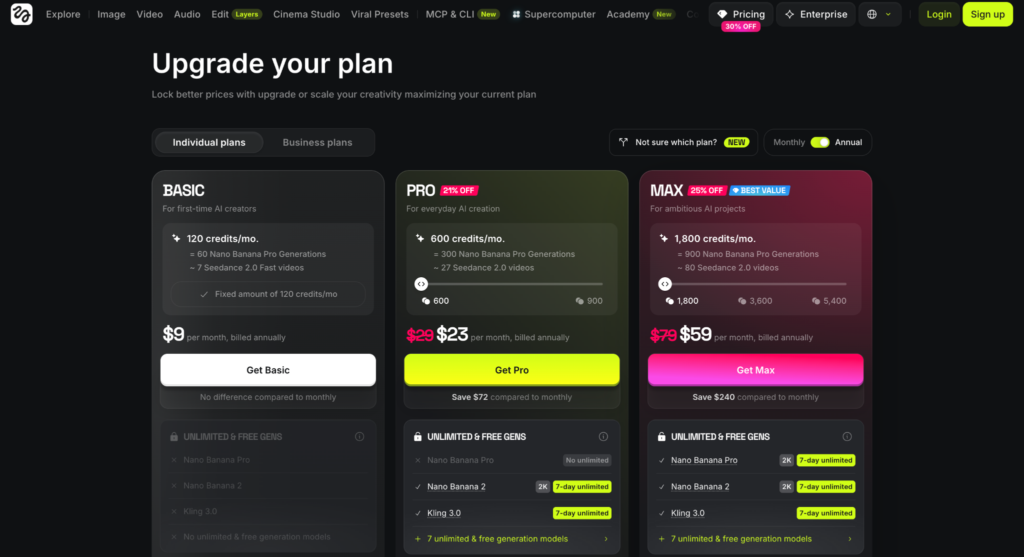
Higgsfield runs a credit-based system with tiers that have shifted multiple times since launch: a free tier, Starter at $15/month, Plus around $34-49/month, Ultra around $84-129/month, and a Business tier around $49-89/seat.
The catch is credit consumption. Kling 3.0 costs roughly 6 credits per generation, but premium models like Sora 2 and Veo 3.1 cost 40 to 70 credits each, meaning the widely advertised “unlimited” label doesn’t apply to the models people actually want to use. One independent breakdown calculated that, after accounting for a realistic 3-5x iteration rate per shot, the $34-49 Plus plan works out to roughly $0.61-$1.03 per usable Kling 3.0 video.
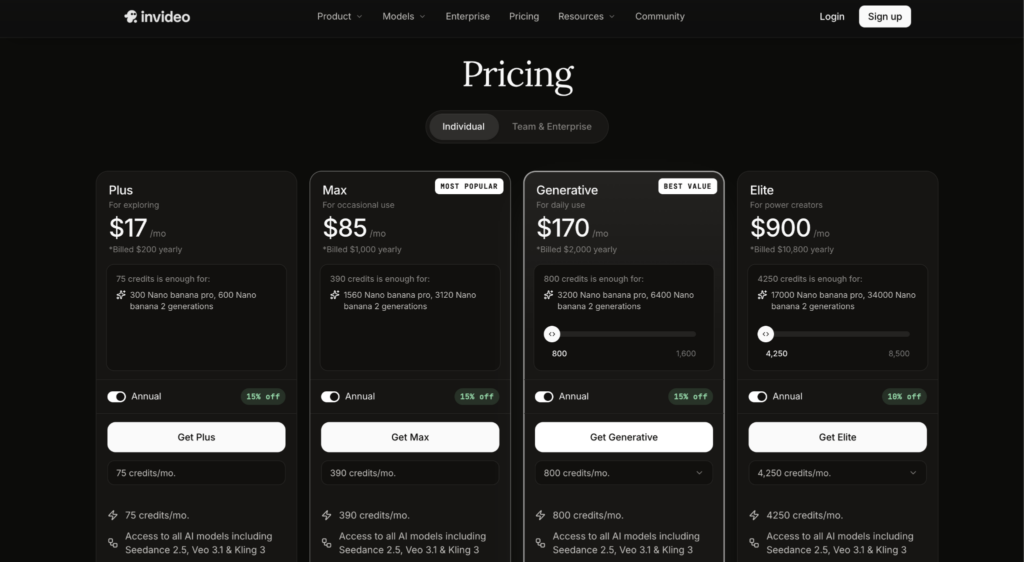
Invideo’s pricing runs across four tiers. Plus starts at $17/month (billed $200/year) with 75 monthly credits. Max runs $85/month (billed $1,000/year) for 390 credits. Generative sits at $170/month (billed $2,000/year) for 800-1,600 credits, and Elite tops out at $900/month (billed $10,800/year) for 4,250-8,500 credits for high-volume production.
Annual billing carries a discount across all tiers (15% off Plus, Max, and Generative; 10% off Elite), and every tier from the entry price point includes access to the full 200+ model library, rather than gating premium models behind a much higher tier the way Higgsfield’s credit costs effectively do.
Where invideo Agent Two Actually Pulls Ahead
This is the part most comparisons miss, because it’s genuinely new. invideo just shipped a 12-part rollout of features under Agent Two that directly targets the exact pain points a Higgsfield-style model-aggregator can’t solve, since those problems live at the agent level, not the model level.
Context and Briefs. Every invideo project now holds a persistent context and memory system, the film’s look, tone, and treatment, or a brand’s guidelines and colors, with individual “Briefs” living inside it for each scene, episode, or campaign film. A character from scene one still looks the same in scene 400, with nothing re-uploaded or re-explained. Higgsfield’s Soul ID tackles a narrower version of this same problem, but there’s no equivalent system holding an entire project’s world in memory the way this does.
Expert Agents. You can hire a full crew of specialized agents, a DOP, a casting director, a costume stylist, a VFX artist, just by writing each one a job description. They brief each other automatically: tell your DOP agent to start shot four, and it pulls the relevant lowdown from the storyboard artist and costume stylist before building. Add a new agent partway through a production, and it walks in already briefed on the whole project. Higgsfield has no equivalent to this multi-agent crew structure, it’s a single interface over many models, not a coordinated team.
Agent Two Has Eyes. Upload literally anything, a script, a PDF, a rough cut, a YouTube link, and the agent reads and understands it. In one real demonstration, the team dropped a rough cut of their short film Juicebox into the agent, and it mapped the footage against the shot list, then flagged actual continuity errors: a flagpole that changed between two shots, and blood on a character’s mouth that was a hotter red than the surrounding color grade in a different shot.
It can also read a reference video’s lighting or camera movement and apply that exact treatment to a new sequence, or read an uploaded ad, detect where a cut happens, and swap in new products while keeping the format intact.
Notebooks and Slate. For manual control, Notebooks give you direct access to the full 200-model library with fine-grained per-generation control, while Slate is a full conversational video editor built into the agent, one that already knows your script and approved takes, supports Premiere Pro and DaVinci Resolve keyboard shortcuts, and lets you say things like “show me three shorter versions of this cut” and get exactly that.
Playbooks. You can teach an agent a standing rule once, always show three style options before locking a location, always prompt a specific model in a specific language, and it follows that rule automatically from then on, without you re-explaining it every time.
Model Access and Camera Control
Higgsfield’s real strength here is genuine: 70+ ready-made camera presets (Bullet Time, Crash Zoom, 360 Rotation, Dolly Shot, FPV mode) through its Cinema Studio, plus a useful DaVinci Resolve plugin that generates footage directly inside an edit timeline, and a Photoshop plugin for sketch-to-image.
invideo covers the same category of camera control, dolly, pan, tilt, track, jib, 360-degree orbit, through named presets applied directly to a still image or existing footage.
This kind of camera movement work sits inside invideo’s broader AI filmmaking approach, where, with Agent Two’s new “eyes,” you can also just upload a clip whose camera move you already like, and the agent reads and reapplies that exact movement to a new scene, something Higgsfield’s preset library doesn’t do, since it works from a fixed menu of moves rather than reading a reference clip.
Character Consistency: The Category’s Real Weak Point
Higgsfield’s Soul ID is its answer to character consistency, and independent reviews are candid that it’s still a work in progress, maintaining the exact same face, outfit, and proportions across separate generations remains harder than the marketing suggests, a limitation reviewers note is common across the category.
Invideo has built the most specifically around this, a genuine priority for anyone doing serious AI filmmaking, locking a character through a multi-angle reference sheet, then treating that reference as the standard every later shot gets checked against, with a self-checking mechanism that flags a shot if it comes back with the wrong face, wardrobe, or location.
An independent Physion-Arc benchmark, 100 prompts, 700 videos across 7 agents, scored invideo Agent One highest on Identity Consistency (79.6) of any agent tested, though that same benchmark also flagged invideo Agent One with the highest celebrity-resemblance risk of the cohort on a separate safety scan, a real caveat alongside the consistency win.
Enterprise and Team Workflows
Higgsfield’s Business tier requires a minimum of 2 seats with a shared credit pool. invideo’s equivalent, launched as part of the Agent Two rollout, goes considerably further: Folders and Connect lets you invite anyone, internal or external, to a specific project folder without adding a seat to your plan, with per-project and per-member budget caps, and full data confidentiality between separate teams working in the same workspace. invideo for Enterprise adds infinite seats, credits that never expire, guaranteed no use of your data for model training, and a stated “infinite memory”, a project can be picked back up at day 1 or day 720 with no loss of context.
Who Each Platform Actually Suits
Higgsfield makes sense if you want hands-on control over which specific model handles a shot, value the camera-preset library and NLE plugin integration, and don’t mind doing the credit math yourself. Its mobile app also gives it an edge for casual, on-the-go generation.
invideo makes more sense for an actual project in AI filmmaking, a series, a multi-scene campaign, a brand rollout, where consistency across many shots and the ability to hand off context to a growing crew of sub-agents matters more than manually picking a model for each shot. Agent Two specifically closes the gap that used to exist between “a tool that generates clips” and “a collaborator that remembers your entire production.”
Common Mistakes When Comparing the Two
- Judging Higgsfield’s pricing from the sticker price alone. Premium model credit costs make the real cost per usable video considerably higher than the advertised monthly rate suggests.
- Assuming Soul ID or any current character-consistency feature fully solves the problem. Independent reviews are consistent that this remains an unsolved, category-wide limitation.
- Comparing raw model count without factoring in who does the model selection. More models in one subscription isn’t the same as not having to choose between them for every shot.
- Overlooking that Agent Two’s memory and crew features solve a different layer of the problem than model access does. A bigger model library doesn’t give you project-level memory or a coordinated agent crew, those are architectural choices, not something more models automatically provide.
- Treating a benchmark win as the whole picture. invideo’s strong Identity Consistency score comes with a documented celebrity-resemblance caveat from the same evaluation.
FAQ
What does invideo Agent Two actually add over the original invideo agent?
Persistent project-level memory (Context and Briefs), a crew of specialized sub-agents that brief each other automatically, the ability to read and understand any uploaded file including full rough cuts, a manual-control Notebooks workspace, a built-in conversational editor called Slate, and enterprise features like Folders and Connect for confidential multi-team collaboration.
Is Higgsfield or invideo cheaper?
It depends on the model and volume. Higgsfield’s entry tiers look cheaper on paper, but premium model credit costs push the real per-video cost higher once iteration is factored in. invideo’s tiers include full model library access at every level.
Which platform has better character consistency?
Both are actively working on this. Higgsfield’s Soul ID is described by independent reviewers as still imperfect. invideo scored highest on Identity Consistency in an independent Physion-Arc benchmark, though that evaluation also flagged a celebrity-resemblance risk worth factoring in.
Can Agent Two read and fix continuity errors in footage I’ve already shot?
Yes. In a real internal demonstration, the team uploaded a rough cut of an in-progress short film, and the agent mapped it against the shot list and flagged specific continuity errors, a changed prop between shots and a color grade inconsistency, without being asked to look for anything specific beyond a general review.