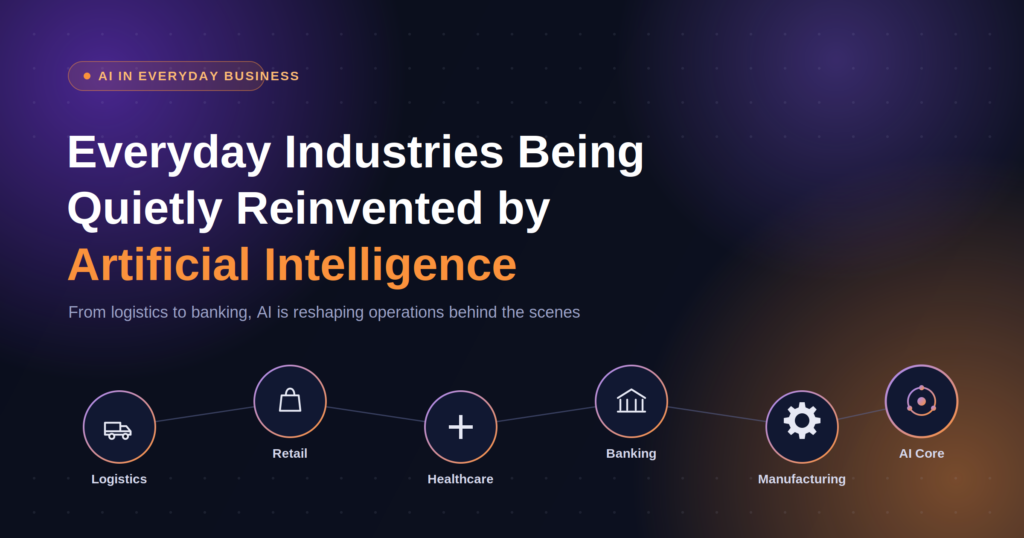
Artificial intelligence has moved well beyond futuristic concepts and tech company laboratories. Today, it’s quietly changing the way everyday industries operate, often without customers even noticing. Rather than replacing entire workforces, AI is helping businesses automate repetitive tasks, analyse data faster, improve customer experiences and make smarter decisions.
Many of the biggest changes are happening behind the scenes, where AI is streamlining processes that once required hours of manual work. As adoption continues to grow, organisations across almost every sector are finding new ways to become faster, more efficient and more responsive. How AI Is Transforming Industries Without You Noticing?
Transportation and Logistics
Transportation has become one of AI’s biggest success stories. Logistics companies use intelligent systems to predict delays, optimise delivery routes, forecast demand and improve fleet management.
Customers often experience quicker deliveries without realising that AI has planned the most efficient route, balanced workloads or predicted traffic conditions before a vehicle even leaves the depot.
Even services like Dallas car shipping increasingly benefit from digital platforms that use intelligent matching, pricing insights and route optimisation to improve efficiency for both transport providers and customers.
Retail
Retailers have embraced AI in subtle but effective ways. Recommendation engines suggest products based on browsing behaviour, inventory systems predict which items will sell fastest, and pricing algorithms respond to market demand almost instantly.
Behind every personalised shopping experience is usually a combination of machine learning and customer data working together.
Healthcare Administration
While headlines often focus on AI in healthcare helping doctors diagnose illnesses, much of its biggest impact is happening behind the scenes.
Hospitals and clinics increasingly use AI to schedule appointments, process paperwork, prioritise patient enquiries and reduce administrative workloads. This allows healthcare professionals to spend more time with patients instead of handling repetitive administrative tasks.
Banking and Financial Services
Banks have relied on intelligent algorithms for years, but today’s AI systems have become significantly more sophisticated.
Modern financial institutions use AI to detect fraud in real time, monitor unusual account activity, assess lending risks, and provide personalised financial recommendations. Many customer support conversations are also handled through AI-powered virtual assistants before a human adviser becomes involved.
Read more about: Best AI-Powered Financial Tools for Budgeting, Investing & SavingManufacturing
Manufacturing facilities are becoming increasingly intelligent through predictive maintenance and automated quality control.
Instead of waiting for equipment to fail, AI analyses machine performance to predict when maintenance should be carried out. Computer vision systems can also identify tiny product defects that may be difficult for the human eye to spot, helping improve consistency while reducing waste.
Hospitality and Travel
Hotels, airlines and travel companies use AI to personalise recommendations, forecast demand, optimise pricing and improve booking experiences.
Many travellers benefit from faster customer service, more accurate pricing and smoother journeys without ever realising that AI has been working behind the scenes throughout the process.
Customer Service
Many businesses now offer 24-hour support through intelligent chatbots capable of answering common questions, directing customers to the right department and resolving simple issues immediately.
The most successful organisations combine AI with human support, allowing staff to focus on more complex or sensitive enquiries while routine requests are handled automatically.
AI’s Biggest Impact May Be the One You Never Notice
The most significant AI transformations are rarely the most visible. Instead of dramatic overnight disruption, many industries are experiencing steady improvements through smarter workflows, faster decision-making and better use of data.
As AI technology continues to mature, its greatest value will likely come from quietly enhancing everyday processes rather than replacing them entirely. Businesses that successfully combine intelligent automation with human expertise are likely to deliver better experiences, greater efficiency and stronger long-term results, while keeping people at the centre of important decisions.

Sapna Ghodasara is the founder of Guide of AI Tool, where she writes in depth reviews of AI tools for marketers, creators and businesses. Her reviews focus on what matters before you pay for a tool: real use cases, honest pros and cons, pricing, and how well it fits into an everyday workflow.
Sapna is the cofounder of SEOMagicLab. That mix of technical training and daily marketing work lets her judge AI tools from two angles: how well the technology actually performs and whether it delivers real value for the people using it.