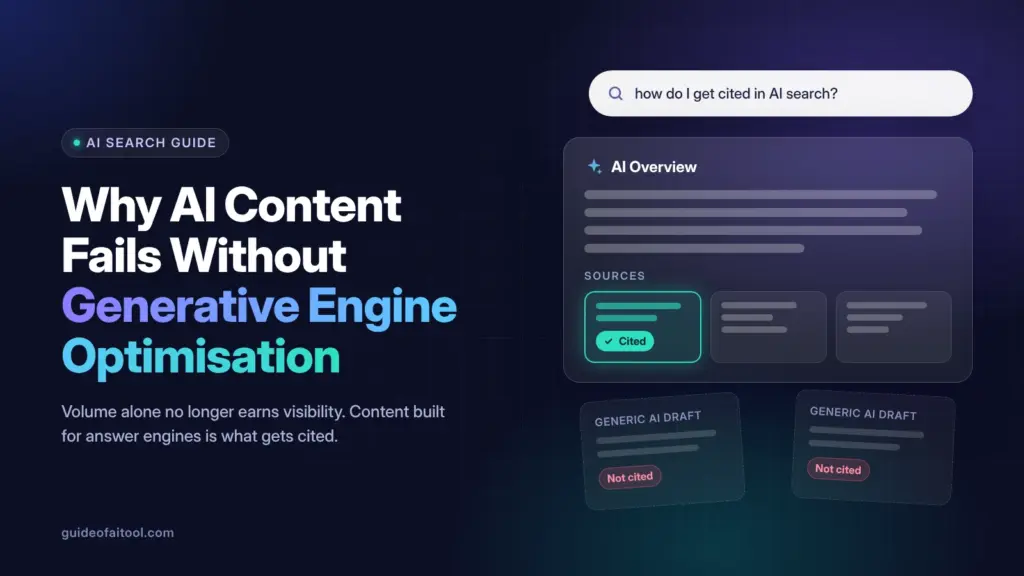
In recent years, generative artificial intelligence has fundamentally changed how digital marketers create content. By late 2026, generating thousands of words takes only seconds. However, producing text at scale is no longer enough to guarantee web traffic. With Google’s AI Overviews and the Search Generative Experience dominating the results pages, traditional ranking methods are losing their effectiveness. To survive this shift, creators must embrace a new discipline known as Generative Engine Optimisation, adapting their strategies to meet the demands of modern answer engines.
The Shift from Search to Answer Engines
The way consumers find information has evolved dramatically. Recent studies show that users click a traditional organic search result only eight percent of the time when a Google AI Overview is present. Furthermore, up to 90 percent of modern B2B buyers now click directly through to sources featured within these AI summaries. This severely reduces traditional clicks to standard websites, forcing digital marketing teams to rethink their approach. People are no longer looking for a simple list of blue links. Instead, they want immediate, synthesised answers that instantly resolve their queries without requiring them to sift through multiple pages.
Search engines have adapted their algorithms to penalise low-effort automated content. In October 2026, Google updated its search quality guidelines to explicitly state that AI text produced at high volumes without manual oversight is classified as spam. Sites relying on generic informational pages have seen massive traffic drops because answer engines now resolve these queries directly at the top of the screen. To navigate this highly technical landscape, many businesses are turning to professional AI driven SEO services in Australia to upgrade their digital visibility. Expert intervention ensures that a brand is strategically structured to appear within these new AI-generated answers, rather than being buried beneath them on the second page of results.
Why Basic AI Writing Falls Short
The primary issue with relying solely on tools like ChatGPT or Jasper for content creation is that they operate as predictive text models. They guess the next most logical word based on vast amounts of training data, but they do not inherently understand natural language processing ranking factors. Pumping out generic articles without a targeted strategy creates shallow content that search engines simply ignore. When thousands of websites publish identical machine-generated perspectives, algorithms filter out the noise to focus on unique, authoritative voices.
While generative tools can certainly help scale production, you need specialised platforms to analyse search engine results pages and integrate crucial keywords. For example, utilising an advanced tool like Surfer SEO helps writers align their text with current readability standards and algorithmic expectations. Without proper analysis of the search results, machine-generated content lacks the contextual depth and structured data required to be cited as a credible source by answer engines. Incorporating these technical elements transforms a basic AI draft into a competitive digital asset.
Core Mechanics of Generative Engine Optimisation
Tracking performance metrics in this new era is significantly more complex than standard search engine optimisation. Success is now based on large language model citations and brand presence rather than traditional keyword positions. Academic data supports the immense value of this strategic shift. A comprehensive study on Generative Engine Optimisation demonstrates that adapting content specifically for AI-driven search engines can boost visibility in generative responses by up to 40 percent. This research underscores why modern marketing budgets must pivot toward structural formatting rather than just volume.
To implement these concepts effectively, content creators need to move beyond basic keyword stuffing and focus on authority signals. Here are the most critical strategies for optimising content in the age of AI search:
- Build strong entity relevance: Focus on brand mentions and clear subject matter authority. Recent data shows that entity relevance correlates much more strongly with AI search visibility than traditional backlink volume.
- Include direct citations: Adding credible source links, specific hard statistics, and verified data measurably improves a brand’s likelihood of being selected and cited in an AI-generated answer.
- Incorporate expert quotes: Search algorithms actively look for original insights from subject matter experts. This differentiates high-quality, human-led content from generic machine output.
- Fact-check meticulously: Current search guidelines mandate manual oversight for all automated content. Generative models can hallucinate facts, and search engines will penalise sites that publish unverified information.
The rapid adoption of artificial intelligence tools means that simply publishing content is no longer a competitive advantage. As of early 2026, a majority of digital consumers actively use AI tools on a monthly basis, highlighting a massive shift from basic curiosity to everyday utility. If brands want to capture this evolving audience, they must stop treating artificial intelligence as a shortcut for mass production. By investing in a dedicated generative engine optimisation strategy, marketers can ensure their content remains visible, credible, and highly relevant in an increasingly automated digital world.

Sapna Ghodasara is the founder of Guide of AI Tool, where she writes in depth reviews of AI tools for marketers, creators and businesses. Her reviews focus on what matters before you pay for a tool: real use cases, honest pros and cons, pricing, and how well it fits into an everyday workflow.
Sapna is the cofounder of SEOMagicLab, an SEO and link building agency serving B2B SaaS, ecommerce and content brands. That mix of technical training and daily marketing work lets her judge AI tools from two angles: how well the technology actually performs and whether it delivers real value for the people using it.