We need AI assistants for every other task now. We ask them to write emails for work, summarize documents, and answer questions about things we don’t have the time to research. But there is still one major problem: AI does not automatically know the context behind every request.
It is like you go to your new employee and say “Write a sales report,” without explaining what the numbers mean, who the report is for, or what format you expect.
Even a smart and capable employee would struggle. AI assistants face a similar problem. They can produce impressive answers, but they work much better when they have the right context.
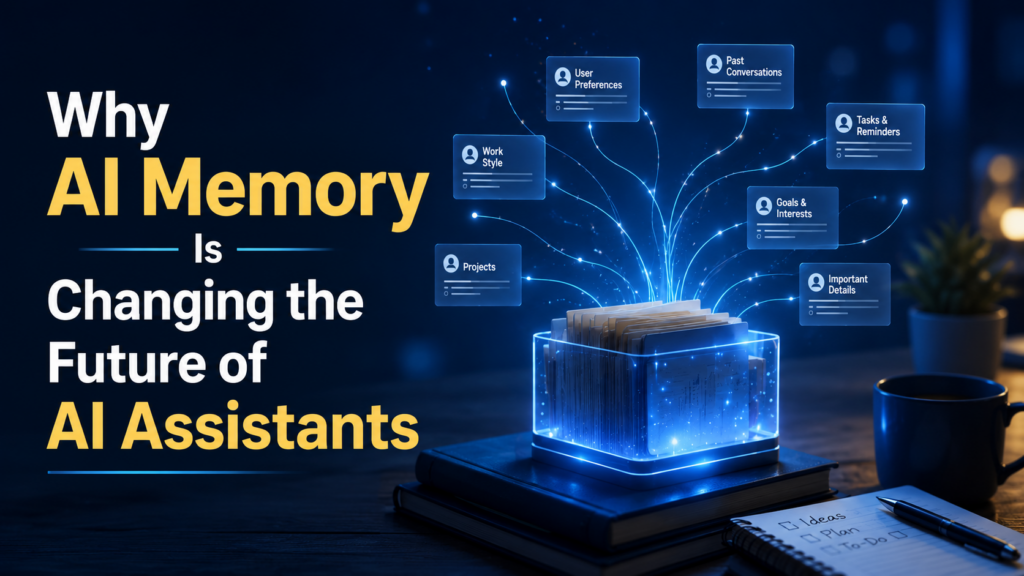
This is the reason AI memory is becoming so important. AI can remember past conversations and, based on that, provide you with the correct information.
In this article, we are going to discuss everything about AI Memory and why it is changing the future of AI Assistants.
What Is AI Memory?
AI memory is the ability of an AI assistant to retain, retrieve, or access information so it can provide more useful and personalized responses.
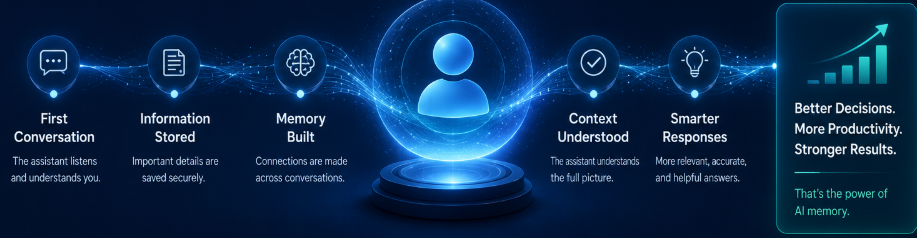
Without memory, every conversation can feel like starting over. You may have to explain who you are, what you are working on, what style you prefer, and what you discussed previously.
With memory, an AI assistant can use relevant information from earlier interactions or connected sources. For example, if you regularly ask for short and simple explanations, an assistant with personal memory may learn that preference and adjust its responses.
AI memory is not just one single feature. It can take several forms, including training memory, session memory, personal memory, external memory, project memory, and organizational memory. Each type serves a different purpose.
How AI Memory Works
The easiest way to understand AI memory is to think about the different layers of information an assistant can use.
AI’s General Knowledge
The first layer is what the AI learned during training. Large language models are trained on huge collections of documents and develop a broad representation of information from those sources.
However, this knowledge has limits. The information used for training comes mainly from particular parts of the world and does not represent every culture or perspective equally. It also does not automatically update information based on how the world is changing.
AI may be trained with lots of information but it does not know what is can changed recently.
Session Memory
Session memory is what allows an AI assistant to follow the conversation you are currently having.
For example, you might first ask:
“Write an introduction about smart homes.”
Then you might say:
“Make it shorter.”
The AI understands that “it” refers to the introduction from the previous message.
The assistant does this by using previous messages in the conversation as context. However, this memory has a limit. Conversations can become too long for the model to process everything at once. Older information may eventually be removed or summarized. In that case, it may seem that the AI has forgotten the old conversations.
Personal Memory
Personal memory goes one step further. Instead of remembering information only during one conversation, an AI assistant can retain useful information about a user for future interactions.
This could include things such as:
- Writing preferences
- Preferred response length
- Professional role
- Recurring projects
- Frequently used tools
- Other useful preferences
For example, if you regularly ask for concise answers, the assistant may remember that preference and adapt future responses.
This makes interactions feel more natural because you do not have to repeat the same instructions every time.
AI Can Access Your Existing Information
AI memory is not always about permanently storing information.
Modern AI assistants can also connect to tools such as email, calendars, cloud storage, notes, and task-management platforms. These connections allow the assistant to retrieve information when it needs it.
For example, instead of remembering your entire calendar, an AI could check it when you ask:
“When am I free for a meeting this week?”
It could also search your cloud storage for an old presentation or find relevant notes from a previous project.
This is important because it means AI does not necessarily need to store everything permanently. It can access the right information when required.
Project Memory Makes AI More Useful for Long-Term Work
Another important development is project memory.
A normal conversation may not contain everything needed for a large project. A project workspace can bring together documents, instructions, previous work, and other information related to one specific goal.
For example, an AI working on a marketing project could have access to:
- Previous campaign materials
- Brand guidelines
- Customer information
- Marketing briefs
- Performance data
- Writing examples
The AI can then use this information while working on new tasks instead of requiring the user to explain the entire project again.
Project memory can also become useful for teams because shared project spaces can allow multiple people to work with the same information and instructions.
Organizational Memory Could Change AI at Work
The biggest shift may happen when AI gets access to a company’s existing information.
Businesses already have huge amounts of organizational memory stored in CRM systems, ERP platforms, databases, sales systems, contracts, customer records, and other tools.
Instead of manually exporting this information into an AI tool every time, connectors can allow an assistant to query company systems directly.
For example, an employee could ask:
“How many customers spent more than a certain amount during the last six months?”
Instead of searching through spreadsheets, the AI could translate the question into a database query and return the relevant information.
This is where AI assistants begin to look less like chatbots and more like digital coworkers that understand the environment in which they operate.
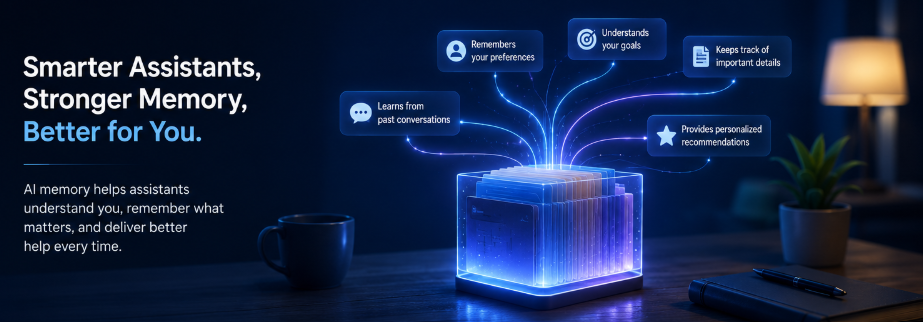
Why AI Memory Matters
AI memory changes the relationship between people and AI.
Without memory, users have to provide context repeatedly. They need to explain their preferences, upload the same documents, and remind the assistant about ongoing work.
With memory, the assistant can build on previous interactions.
This can make AI:
More personalized: It can adapt to how an individual works.
More efficient: Users spend less time repeating information.
More consistent: The assistant can follow previously established instructions and preferences.
More useful for long-term work: It can maintain context around projects rather than treating every request as a completely new task.
The result is a move away from isolated prompts toward ongoing collaboration.
AI Memory Still Has Limits
Stored information can become outdated or irrelevant. Personal memory can also have limited capacity, meaning users may need to review, correct, or remove information over time.
There is also an important difference between remembering information and understanding it. Simply giving an AI access to more data does not automatically turn that data into useful knowledge.
For more advanced systems, technologies such as Retrieval-Augmented Generation (RAG), knowledge graphs, and ontologies can help organize information and connect different pieces of data.
The Future of AI Assistants Is About Context
The most significant change for AI assistants is not really building bigger and faster models. It is more about providing their models with access to appropriate context. Useful AI needs more than just a general knowledge base.
It must understand the conversational context, remember user preferences, be able to access documents and other information, take direction related to a project and, if applicable, retrieve information from the systems people already use.
The next generation AI assistant will not merely ask you, “what would you like me to do?”
AI will eventually grasp things like your identity, your current endeavors, your prior experiences, and the nature and scope of the problem or issue for which you need a solution or help.
That shift could turn AI assistants from tools we repeatedly instruct into digital collaborators that can support us over time.
FAQs
What is AI memory?
AI memory allows assistants to remember or access useful information for better responses.
Why is AI memory important?
It helps AI understand context and reduces the need to repeat information.
Can AI remember user preferences?
Yes. It can remember things like writing style, preferences, and recurring projects.
Can AI memory help with projects?
Yes. Project memory lets AI use documents, instructions, and previous work related to a project.
Can AI access information from other tools?
Yes. AI can connect with email, calendars, cloud storage, notes, and other tools to retrieve information.
Does AI memory remember everything?
No. AI memory has limits, and stored information may need to be updated or removed.
How will AI memory change the future?
It can make AI assistants more personalized, consistent, and useful for long-term work.