Various forms of artificial intelligence software are available; for instance, ChatGPT, Gemini, Claude, and Microsoft Copilot. These technologies are all capable of answering questions, explaining various issues, summarizing lengthy articles, and offering writing assistance.
They can help save a lot of time and facilitate the learning process. Indeed, according to a 2025 HEPI survey among 1,041 undergraduate students, 92% of participants have used AI in some form, and 88% used generative AI for their assessments. Hence, artificial intelligence became an inseparable part of the students’ lives very quickly.
At the same time, there is no guarantee that information provided by AI is true and trustworthy. Artificial intelligence often provides false information, invents new facts, and even makes up references. Moreover, AI tends to omit some details or provide information from a certain angle. That is why students need to evaluate AI generated sources carefully instead of using them blindly.
Why AI-Generated Content Should Be Checked
Most students assume that if the AI’s response sounds confident, then it is the right answer. However, it is not necessarily the case.
The AI generates the answers by predicting what would be the best-fit words to use after analyzing the training dataset. AI does not think like humans, nor does it know the facts like us. Therefore, sometimes it comes up with false information that sounds credible but is not true.
This is why students should critically evaluate information generated by AI tools before relying on it in academic writing. Even when using a grammar checker to improve the clarity and correctness of their writing, students should verify factual claims and ensure that the original meaning remains accurate.
For instance, the AI can make such mistakes as:
- Providing the wrong date for a particular historical event.
- Quoting a scientific study incorrectly.
- Creating books and journal articles out of thin air.
- Providing website links and references that never existed.
- Using facts from multiple sources to give one wrong answer.
These errors are referred to as AI hallucinations.
Start by Asking Questions
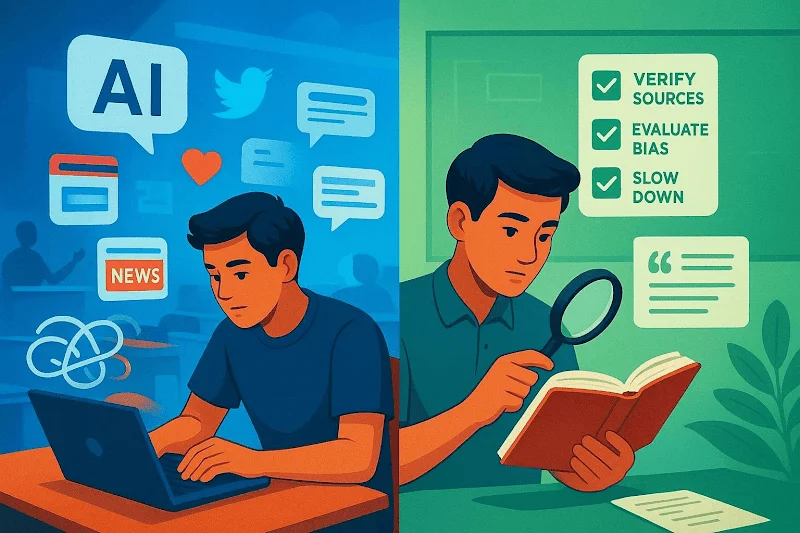
Every time you get any information from AI, you should not accept it right away but ask yourself the following questions:
- Is this information accurate?
- Where was this information obtained?
- Can I confirm the correctness of the facts mentioned?
- Does the information contain credible evidence?
- What else is missing in the answer?
- Is there anything that could bias me?
Check the Facts
The initial stage involves confirming the facts that matter. If you get numbers, dates, people’s names, definitions, or anything scientific from AI, check it with credible sources.
Such credible sources are:
- government websites
- university websites
- textbooks from school
- academic journals
- credible news outlets
- professional organizations
If a lot of credible sources confirm the same information, then it’s most probably correct. Always remember that it’s unwise to base all your information on one response from AI when doing school assignments.
Look at the Sources
AI can also offer citations. Although they appear to be real, they may not be accurate. Before using any source, verify if the source even exists.
Asking yourself the following questions might help:
- Is this article a real one?
- Is the author real?
- Did it get published by an authentic entity?
- Am I able to find it on the Internet?
- Is the citation consistent with the data offered by AI?
If you are unable to find this source at all, then it was created by AI.
Check Who Published the Information
Not all websites are reliable. Sources that can be considered reliable normally include:
- Universities
- Government bodies
- Scientific groups
- Professional associations
- Well-known educational establishments
Beware of information available from sources that you are not familiar with, such as blogs, random websites, and social media, without any evidence. Reliable sources give credit to their sources of information.
Watch for Bias
The AI learns from the information available from various sources over the internet. As a result, it can be biased in its learning process. Bias is the state where information favors one perspective and ignores all other perspectives about a certain issue.
For example, the AI can be:
- Favoring one perspective.
- Ignoring relevant information.
- Using stereotypes.
- Showing favoritism for a certain country or culture over others.
While researching any topic, it is advised that you use information from various sources.
Check Whether the Information Is Current
Some subjects are fast-moving. Such as:
- Technology
- Medicine
- Laws
- Government policies
- Artificial Intelligence
- Climate studies
AI might give you out-of-date information. Always consider the publishing date for your sources when working on such subjects. The use of the latest information will make your work more accurate.
Make Sure the Answer Is Complete
Occasionally, AI provides only a partial answer.
For instance, when you seek information about climate change, AI will provide information on how this phenomenon occurs and will fail to mention the consequences of the changes and any ways to solve this problem.
A proper answer should include:
- The central idea
- Details
- Examples
- Various opinions if required
- Evidence
If the answer is too brief or lacks some important information, keep researching. Students can also turn key concepts into spaced repetition flashcards to review important information over time, reinforce their understanding, and identify areas that need further study.
Look for Supporting Evidence
Academic writing depends on evidence, not on opinion. Consider whether:
- Does the explanation state the sources of the information?
- Does it contain research results?
- Does it cite any research or experts’ opinions?
- Is there an ability to verify the information?
Strong evidence enhances the credibility of the information. Do not use the information provided by AI if it is not backed up with evidence.
Compare AI with Other Sources
A good way to analyze AI-generated content is by comparing it with credible resources.
Consider:
- Textbook
- Academic research papers
- University website
- Government sources
- Educational websites
If the sources mentioned above support the AI’s response, then the information is reliable. If the sources contradict the AI response, you need to look deeper into the matter to know which one is right. Comparison of sources also helps you understand your topic better.
Be Careful with AI Citations
Sometimes AI can generate perfectly looking citations that do not actually exist at all. This means it can come up with:
- Authors
- Journal names
- Book titles
- Publication dates
- Digital Object Identifiers (DOIs)
It is always advisable to search for all of the citations before including them in your assignment. Otherwise, your assignment quality may become compromised.
Think Critically
Critical thinking involves questioning and analyzing information rather than accepting it blindly.
Traits of effective critical thinkers:
- Question things.
- Find evidence.
- Consult various sources.
- Evaluate from multiple perspectives.
- Think before believing information.
Critical thinking is probably the most crucial skill for students to learn in relation to AI technology.
Use AI as a Learning Tool
Do not let AI do your thinking. Rather than having AI do your homework, use AI to:
- Help you understand complex ideas.
- Summarize lengthy readings.
- Provide study questions.
- Think of ideas.
- Take practice tests.
- Improve your grammar and writing.
Tools such as AI quiz generators and free paraphrasing tools for students fit well here, but always check the information before using it. It is important to learn and still have good results.
Common Mistakes Students Should Avoid
There are some similar mistakes that many people make when working with AI. These mistakes should be avoided:
- Believing all answers provided by AI.
- Copying texts provided by AI without verification.
- Using fake references created by AI.
- Not checking facts.
- Relying only on one source.
- Neglecting the dates of publication.
- Believing information because it seems to be professional.
The following mistakes can be avoided by doing better research.
A Simple Evaluation Checklist
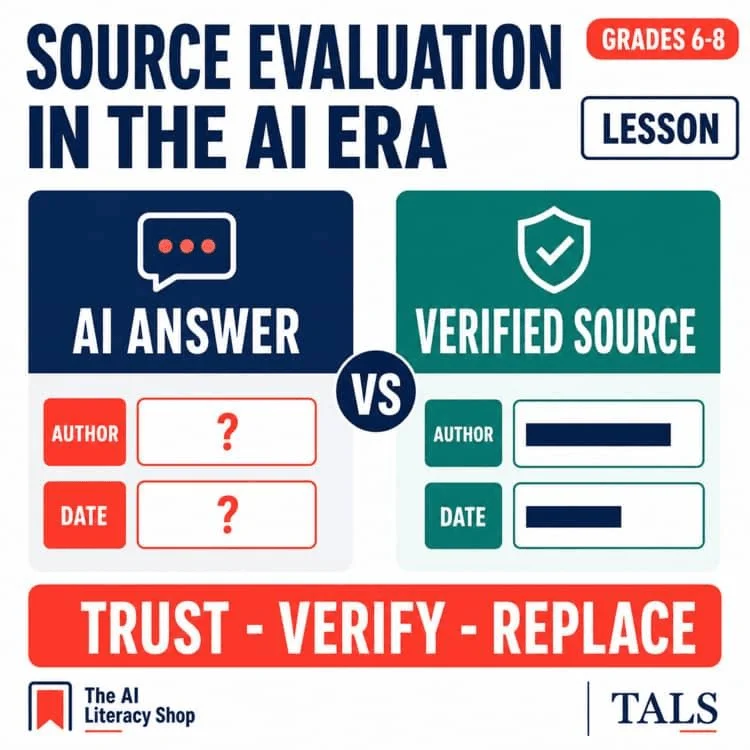
Here are some questions that will guide you before employing AI-generated information:
- Is the information correct?
- Is it verifiable from other sources?
- Are the sources genuine?
- Is the publisher credible?
- Is the information up-to-date?
- Is there enough evidence provided for the answer?
- Is the information exhaustive?
- Is there a bias?
- Have I compared the information with other credible sources?
If your answer is affirmative to most of these questions, then the information is highly credible.
Final Thoughts
Despite being a useful learning tool, AI is not a foolproof means for gathering information. In fact, it may be prone to errors, generate fake information, cite sources that are non-existent, and provide skewed or one-sided answers. This is the main reason why no student should depend solely on AI while working on assignments or conducting research.
The right approach would be to treat AI as an initial source, not as the final source. For this purpose, one should make sure that the facts are validated, that one turns to real sources, cites sources appropriately, takes into consideration different viewpoints, and applies critical thinking. In this way, students will learn how to work with AI correctly.