Markets are moving at lightning speed, and the amount of information traders are required to process has never been higher. Price charts, financial statements, news stories, social media activity, and even blockchain data all scramble for our attention, and there’s no way to keep up, but that is exactly what AI trading products are designed to do.
Disclaimer: This content is for informational purposes only and is not financial advice. Trading involves risk, and you can lose some or all of your investment.
What are AI Trading Tools?
AI trading tools are AI tools that use AI, machine learning, natural language processing, and predictive analytics to understand financial markets and support trading decisions. Huge volumes of data are processed, along with pricing history, trading volume, news headlines, earnings reports, and social media sentiment. This information helps in making better decisions that a human might not have thought of.
AI trading tools are trained to have excellent pattern recognition skills that scan for opportunities, manage portfolios, or execute trades automatically based on preset rules. Not every tool is completely automated, and some are simple stock screeners.
Benefits of Using AI Trading Tools
Speed and efficiency
AI can scan thousands of assets in seconds and flag setups.
Data-driven decisions
Many trading decisions are taken on the basis of a gut feeling. And most people who trade do not really have any actual knowledge about trading. With AI trading tools, it is possible to base decisions on quantitative analysis and statistical probabilities.
Emotion-free trading
Fear and greed are common causes of poor trades. Automated systems follow their rules consistently, without panic selling or chasing rallies.
24/7 market monitoring
This is especially useful in cryptocurrency markets, which never close. A bot can watch prices and react while you sleep.
Backtesting and strategy testing
Many platforms let you test a strategy against historical data before risking real money, helping you refine your approach.
Risk management features
Tools can automate stop-loss orders, position sizing, and portfolio rebalancing to keep exposure within your limits.
Accessibility
Features that once required a quant team or expensive terminals are now available to individual investors at a modest cost.
AI Trading Tools for Stocks vs. Cryptocurrency
While the underlying technology bears similarities, the difference in the market’s nature makes a notable difference in terms of functionality and priorities.
Market Hours
Markets have limited hours, with the possibility of making deals before opening and after closing, but cryptoassets are available for trading around the clock, 24/7.
Volatility
Price may increase or decrease by 10% or even more on a daily basis, while price changes of most stocks are rarely steeper. Grid trading and arbitrage opportunities are much more common in crypto than in traditional finance.
Data availability
Traditional finance data includes financial statements of companies, regulatory reports, ratings of stocks issued by analysts, macroeconomic indicators, and industry trends. In crypto, information about on-chain transfers, exchange orders, social sentiment, and whale activity is more important.
Regulation
Securities are subject to strict regulation, and any trade is conducted within the framework of several securities laws to protect investors. The crypto market is less regulated, and promoters of fraudulent schemes are numerous.
Liquidity
Most large company stocks are extremely liquid and ready to buy/sell on demand, while low-volume cryptoassets may experience idiosyncratic risks such as slippage and wash trading.
Tools
In traditional finance, AI screeners, robo-advisors, and signal services are the norm, while in crypto, automated trading bots with access to API keys dominate the market.
AI Trading Tools at a Glance
| Tool | Category | Main Features | Best For | Trading Type |
| AltIndex | AI Stock Analysis | Alternative data, stock signals | Stock investors | Stocks |
| Coinrule | Automated Trading | Rule-based bots, strategy automation | Beginner traders | Crypto |
| TrendSpider | Technical Analysis | Charting, trendlines, backtesting | Technical traders | Stocks, Crypto |
| Tickeron | AI Trading Signals | Pattern recognition, market forecasts | Signal-based traders | Stocks, ETFs, Crypto |
| Akshaya AI | AI Trading | AI-driven market analysis | Traders seeking AI insights | Verify supported markets |
| Trade Ideas | AI Stock Trading | Holly AI, stock scanners, backtesting | Active stock traders | Stocks |
AltIndex
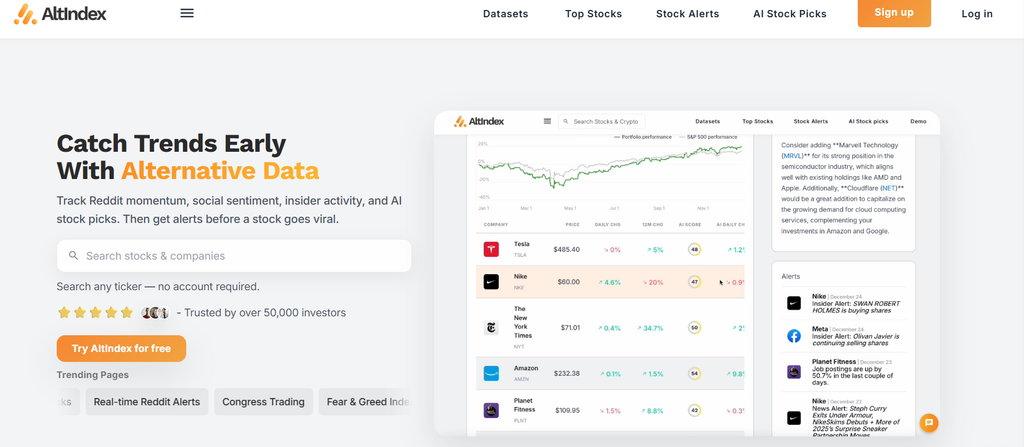
AltIndex is an AI-powered stock analysis platform that uses alternative data, social media activity, and market trends to identify potential investment opportunities. It helps investors track stock sentiment and discover companies attracting market attention.
Features
- AI stock analysis
- Alternative data tracking
- Social media sentiment analysis
- Stock alerts
- Company performance insights
- Investment signals
Strengths
- Offers alternative market insights
- Helps identify emerging stock trends
- Easy-to-understand investment signals
Weaknesses
- Primarily focused on stocks
- Some features require paid plans
Coinrule
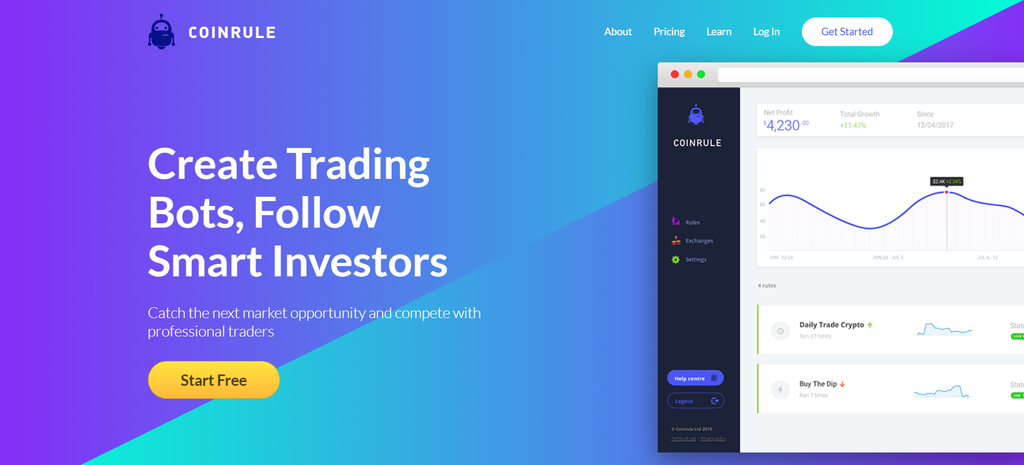
Coinrule is an automated crypto trading platform that allows users to create trading strategies using simple rules without coding. It helps traders automate buying and selling based on market conditions.
Features
- Automated crypto trading
- No-code trading rules
- Strategy templates
- Exchange integrations
- Trading bots
- Backtesting tools
Strengths
- Beginner-friendly interface
- No programming skills required
- Automates repetitive trading tasks
Weaknesses
- Features vary by plan
- Trading involves cryptocurrency market risks
TrendSpider
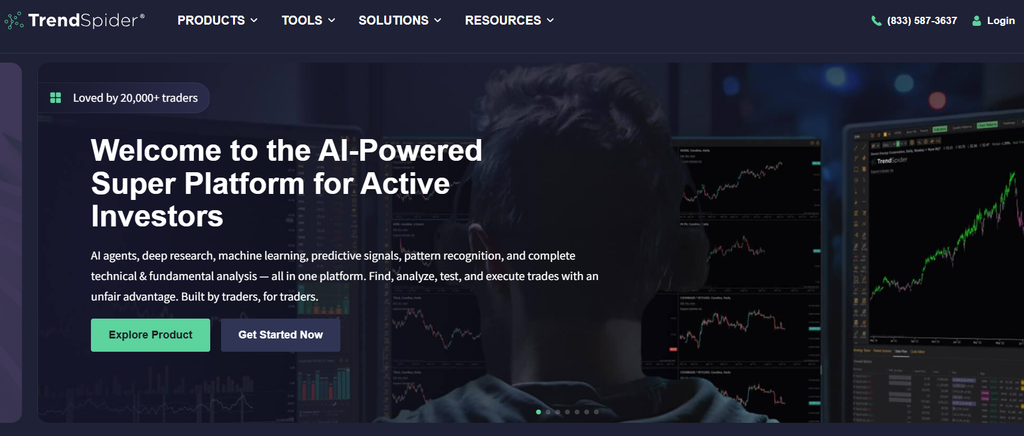
TrendSpider is a technical analysis platform that helps traders analyze financial markets using automated charting and AI-powered tools. It offers features for identifying trends, scanning markets, and testing trading strategies.
Features
- Automated technical analysis
- Trendline detection
- Advanced charting tools
- Market scanners
- Strategy backtesting
- Trading alerts
Strengths
- Reduces manual chart analysis
- Offers advanced technical tools
- Supports strategy testing
Weaknesses
- Can take time to learn
- Paid plans may be expensive for beginners
Tickeron
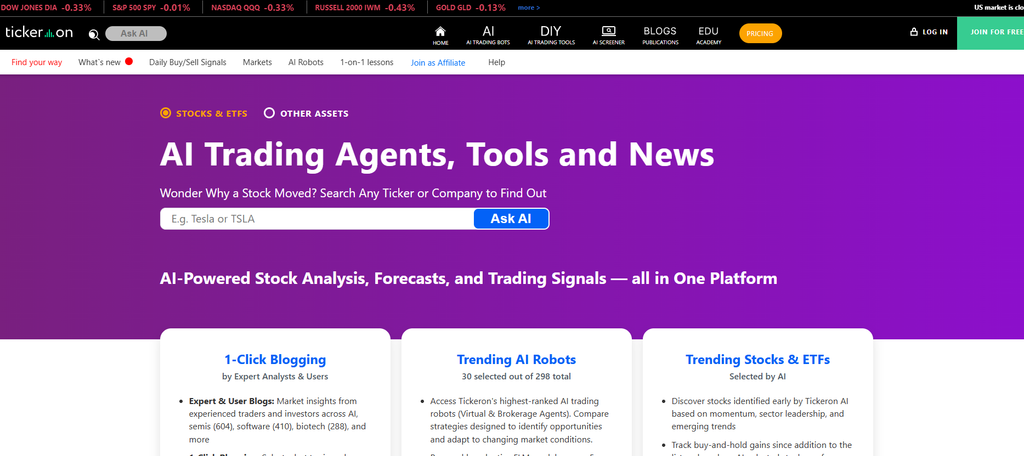
Tickeron is an AI-powered trading platform that uses machine learning to identify market patterns and generate trading signals. It offers AI trading robots, stock forecasts, and analytical tools to help traders evaluate potential opportunities.
Features
- AI trading signals
- Pattern recognition
- Market predictions
- AI trading robots
- Stock and ETF analysis
- Trading performance insights
Strengths
- Provides AI-based market insights
- Offers multiple trading tools
- Helps identify potential market patterns
Weaknesses
- Some tools require paid subscriptions
- Predictions are not always accurate
Akshaya AI
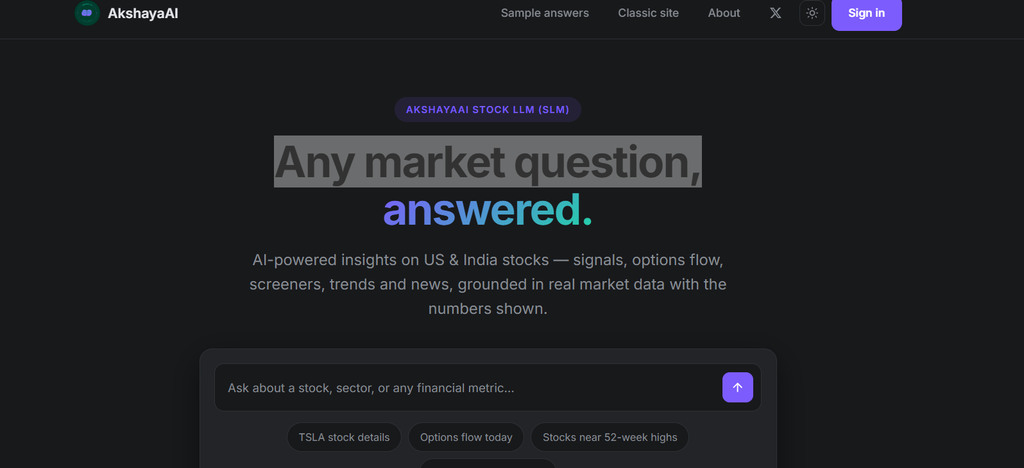
Akshaya AI is an AI-powered stock analysis assistant designed to help users understand market data and evaluate trading opportunities. It supports stock research by providing analytical insights, technical indicators, and market-related information.
Features
- AI stock analysis
- Technical indicators
- Stock market insights
- Price trend analysis
- Market news
- Trading signals
Strengths
- Simplifies stock research
- Helps users interpret market information
- Useful for exploring trading ideas
Weaknesses
- Features may vary by market
- AI insights require independent verification
Trade Ideas

Trade Ideas is an AI-powered stock trading platform built primarily for active traders and day traders. Its Holly AI system analyzes market data to identify potential trading opportunities, while stock scanners and backtesting tools help users evaluate strategies.
Features
- Holly AI trading assistant
- Real-time stock scanners
- Trading signals
- Strategy backtesting
- Custom stock alerts
- Market analysis tools
Strengths
- Designed for active stock traders
- Powerful stock scanning features
- Supports strategy evaluation
Weaknesses
- Premium plans can be expensive
- Beginners may face a learning curve
Risks of Using AI Trading Tools
These are some things to keep in mind before using AI Trading Tools.
No guarantee of profits
Marketing claims about high returns are often exaggerated. Past performance and backtested results do not predict future outcomes.
Overfitting
A strategy tuned too closely to historical data may look impressive in testing but fail in live markets.
Market shocks
AI models trained on past conditions can struggle with unprecedented events such as sudden crashes, regulatory announcements, or geopolitical surprises.
Scams and fraud
The space is full of fake “guaranteed return” bots and fraudulent platforms. Be wary of any tool that promises unrealistic profits or asks you to send funds directly to an unknown party.
Over-reliance
Trusting a tool blindly without understanding its logic can lead to large losses. Human oversight remains important.
Technical failures
Bugs, connectivity problems, API outages, or exchange downtime can cause missed trades or unintended orders.
Security concerns
Connecting a bot to your brokerage or exchange account exposes you to risk if the platform is hacked. Use API keys with withdrawal permissions disabled and enable two-factor authentication.
Costs
Subscription fees, trading commissions, and spreads can eat into returns, especially for high-frequency strategies.
Frequently Asked Questions About AI Trading Tools
Are AI trading tools legal?
Generally, yes, since using such services does not imply any illegality in and of itself, as long as one uses a legitimate marketplace that complies with the law in one’s jurisdiction. It is essential to ensure that one’s jurisdiction allows for the use of such tools.
Can AI trading tools guarantee profits?
Not necessarily, since, by definition, markets are unpredictable, and no tool can be fully reliable, so it is vital not to fall for scams promising guaranteed results.
Do I need to know how to code to use AI trading tools?
Not necessarily, since there are visual, codeless interfaces, pre-written strategies, and the ability to code one’s own strategies if one knows how to.
How much money do I need to use AI trading tools?
It depends on the goals and the tools; some are designed for micro-investments, while others require more significant stakes. Some even have a paper trading option, which allows one to practice without risking any money.
Are AI trading tools safe?
One must ensure that the company one uses is legitimate and has a good reputation, as well as check the security details and never give access to private keys or allow the bot to withdraw funds.
Are AI trading tools better than humans?
They cannot replace humans in trading, as human expertise and experience can be crucial in markets, where emotions often drive prices; however, their speed and lack of emotional bias can be beneficial in specific scenarios.
Can a beginner use AI trading tools?
One should learn the basics before trading with real money, paper trade, and only then start investing substantial sums.