Most advice about picking an AI writing tool is written for people producing blog posts. Which model sounds most natural, which one handles a brief well, which one is cheapest per thousand words. All of that is fair, and almost none of it survives contact with a book.
A book is not a long article. It is a different job, and it breaks tools in ways that only show up around chapter eight, long after you have paid for a year up front. So here is what to actually test before you commit, based on the failures that keep repeating.
AIWriteBook: Built Around the Book, Not the Chapter
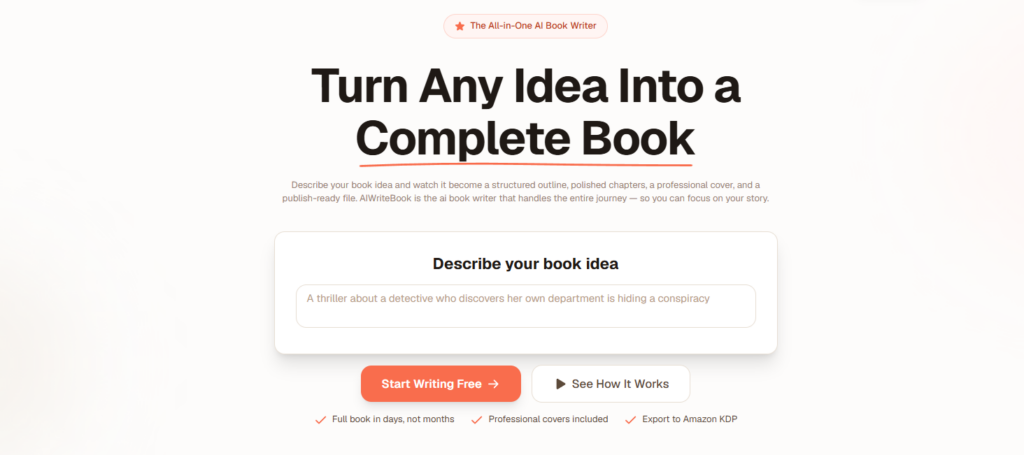
A book does not end with only one chapter and may consist of many chapters. AIWriteBook is a useful tool for those who are writing a full length book.
Start with one of your own chapters and check how closely it follows your voice, pacing, and level of detail. Then build the outline, change a few points, and generate chapters from different parts of the manuscript.
This gives you a better sense of how it handles a book as a whole. If character details stay consistent and chapter twenty still sounds like the same writer as chapter two, the tool becomes more worth considering. The workflow matters too.
You need enough control to revise the outline, change individual chapters, and edit the final text yourself. A long list of AI features matters less if you lose control of the manuscript halfway through.
What Changes at Book Length
At 800 words, a language model has your whole piece in front of it. Tone stays put. Facts stay put. Nothing contradicts anything, because there is not enough text for a contradiction to hide in.
At 60,000 words, none of that is free anymore. Your protagonist’s sister is called Ana in chapter three and Anna in chapter nineteen. The voice you liked in the opening has quietly drifted into the flat, agreeable register that models default to when nobody stops them. A rule you set in chapter one about how magic works, or how the chapters are structured, is gone by the middle of the book.
None of this happens because the model is bad. It happens because holding one voice and one set of facts steady across a whole manuscript is a separate engineering problem, and a chat window was never built to solve it.
Test One: Give It Your Own Writing First
The single most useful thing you can do to a candidate tool is feed it something you wrote, then ask for a page in that voice.
Check Whether It Sounds Like You
Read the result and ask one question: Would a reader who knows your work believe you wrote this?
Not “is it good”, not “is it grammatical”. Would they believe it?
Generic tools usually fail here in a specific way. They produce competent prose that belongs to nobody. If your voice is the reason people read you, that is the whole game lost, and no amount of speed makes up for it.
Look for Voice-Matching Features
Tools built for books tend to work the other way round. You upload your existing books or drafts, and the tool learns your pacing, your dialogue, your chapter rhythm, and writes from that.
If you have three books of a series out already, this is the difference between writing book four in your own world and writing it in a stranger’s.
Test Two: Does It Plan Before It Writes?

Ask for a book and watch what arrives first.
If It Starts Writing Chapter One Immediately
If chapter one appears immediately, you are using a text generator. It has no idea what chapter twelve is, so chapter one cannot be pointing at anything.
You will find this out much later, when the ending does not land and you cannot work out why.
If It Creates an Outline First
If an outline appears first, and you can edit that outline before a single chapter is drafted, you are using something built for books.
That editing step is where you keep control of the story. It costs you an hour and saves you a rewrite.
Test Three: Run It Past Chapter Twenty
This is the test nobody does during a free trial, and it is the one that decides whether you finish.
Get the tool to chapter twenty, then check three specific things.
Check Character and Place Names
Are the names still spelled the same way?
A long manuscript can expose small inconsistencies that are almost impossible to notice when testing a tool on a single chapter.
Check Rules and Story Details
Does it still remember rules you established early?
This matters especially for fiction with recurring characters, fictional worlds, timelines, magic systems, or complex plots.
Check Voice Consistency
Does chapter twenty sound like chapter two, or has the voice flattened?
You can shortcut this. Ask the tool directly what happens to consistency across a long manuscript, and see whether the answer is a real mechanism or a marketing sentence.
Anything that talks about context windows without explaining what happens when the book exceeds one is telling you it has not solved the problem.
Test Four: Ask What Happens After the Draft
Here is where most writers get ambushed, and it has nothing to do with the writing.
Say the tool works. You have 60,000 words you are happy with. You are now alone with the formatting, the cover, the front and back matter, the metadata, the print PDF that Amazon will reject twice for margins, the ebook file, and the question of how any reader is ever going to hear about it.
Check the Publishing Workflow
The AI writing tool is long gone by this point. That is the moment the project quietly stops for a lot of people, and it is worth choosing for it in advance.
Some tools carry the book through export, cover, formatting, and distribution in the same place. Some hand you a text file and wish you luck.
Both are legitimate, but you should know which one you are buying.
Test Five: Check Who Is Still the Author
Ask whether you can edit at every level.
Check Outline Editing
Can you change the outline before drafting begins?
Check Chapter Editing
Can you rewrite any chapter afterwards without fighting the tool?
Check Manual Editing
Can you edit individual paragraphs by hand, without the tool overwriting your changes the next time it runs?
A tool that only offers regenerate is not giving you a book. It is giving you lottery tickets. You will get closer to what you wanted by accident, eventually, and you will not be able to say the result is yours.
The version of this that works looks boring on a feature list. You approve the plan, the machine does the mechanical work, and every decision that shapes the book stays with you.
A Practical Way to Test an AI Book Writer in One Afternoon
You do not need a month to make this decision.
Step 1: Use a Chapter as a Voice Sample
Take a chapter you have already written. Feed it in as a voice sample.
Step 2: Ask for a Book Outline
Ask for an outline for the book it belongs to.
Step 3: Edit the Outline
Edit two things in that outline on purpose, and see whether the edits actually change the chapters that follow.
Step 4: Generate Three Chapters
Generate three chapters from different parts of the book and read them next to each other. If the three chapters sound like the same person, and that person is you, the tool is worth paying for.
If they sound like three different competent strangers, no discount will fix it.
Step 5:Check the Free Trial Before You Pay
One more thing worth checking before you pay: how much you can do without entering a card.
A tool that is confident about voice matching will usually let you find out whether it sounds like you before it asks for money. With an AI book writer, this matters more than in most software categories, because the thing you are testing is not a feature. It is whether the output is recognisably yours.
Conclusion
Book length punishes tools that were designed for short form, and it punishes them slowly enough that you will not notice until you are invested.
Test voice on your own writing. Insist on an outline you can edit. Push past chapter twenty before you trust it. Find out what the tool does after the draft is finished. And make sure you can still change any sentence in the book by hand.
Speed was solved years ago. The two things that still stop books are people not finishing them and the result not sounding like the person who wrote it.
Pick the tool that takes those two seriously, and then, all you have to do is type.
FAQs
What is an AI book writer?
An AI book writer will assist you in outlining, writing, and editing a book. The AIWriteBook tools are intended to facilitate the entire book-writing process.
Will AIWriteBook write an entire book?
Yes, it will produce an entire book including its outline and book chapters.
Can AIWriteBook write a fiction book?
Yes, you can write fiction books and any other format of books such as non-fiction, memoirs, self-help, etc. With AIWriteBook.
Can I contribute my own writing to the book?
You may do so by providing your existing writing or drafted material as input.
Does AIWriteBook create an outline?
It creates a book outline before its chapters in order for you to make amends to it first.
Can I edit the text generated by AIWriteBook?
Yes, you can edit all of the content generated.
Can AIWriteBook generate a book cover?
Yes, it features tools that enable book cover generation among other resources for publishing.
Can AIWriteBook help in publishing my book?
Yes, the tools can be used to export your book and other publishing-related processes, which support export formats recognized on popular platforms like Amazon KDP.